Showing posts with label providence. Show all posts

12 November 2013

Strange Fire Conference #7: Phil Johnson

by Dan Phillips

I'll combine my comments on Phil's sessions, Is There a Baby in the Charismatic Bathwater? and Providence Is Remarkable.

Phil Johnson's voice is, to my mind, one of the sanest and most helpful on a host of issues related to Charismaticism.

Before I knew there was such a thing as a Phil Johnson, I had been in the movement for the first years of my Christian life, and I'd given it a lot of study and thought. I'd even written a book (as-yet unpublished) on the person, work and gifts of the Holy Spirit, which countered such branches of Charismaticism as existed by the 90s. I'd read every book I could get my hands on. Yet what I encountered in Phil's posts at the original Pyromaniac site expressed the most insightful thinking and lucid, incisive commentary I'd ever read. Phil's absolute classic, You're probably a cessationist, too, is a perfect example.

So I wasn't in any suspense as to whether the time invested in hearing Phil would be well-spent.

In the first session Phil responded at great length to Dr. Michael "I-Denounce-All-Aberrations-Though-I-Can't-Put-My-Finger-On-Any-Specific-Ones-Just-Now-I'm-Really-Busy" Brown, as well as to the rationale for all Charismatic leaders' blithe neglect concerning the chicanery and shenanigans with which the movement is riddled. In response to Charismatic leaders' unintentionally telling plea that they just don't have enough time to denounce all the false teachers in the movement, Phil appositely pointed to texts such as Titus 1:9. Turns out that denunciation of error is definitional for elders. In the Bible, that is. Go figure.

Phil also responded to the squawks about MacArthur's earlier observation that some Charismatics are guilty of blaspheming the Spirit. Phil observed that attributing to the Spirit words He hasn't said and deeds He hasn't done — the heart and soul of Charismaticism as to its distinctives — is blasphemy, and it is a sin. It is not the blasphemy against the Spirit of which Jesus spoke in Matthew 12:31, but it is blasphemy, and it does injure the name and majesty of the Third Person of the Trinity. That Charismatic leaders not only merrily tolerate and turn a blind eye to the constant flow, but indeed run cover and develop rationales for it, lowers hopes for locating a healthy infant in the bilge.

Phil noted the Charismatics' instant impulse to circle the wagons at even the most obvious criticisms, and asked "If you bristle at every critique of your movement, what is your proposal to keep from constantly accumulating filth in your bathtub?"

As an example of the patently obvious, Phil dwelt on the so-called Lakeland Revival, and its ringleader Todd Bentley. He detailed Bentley's love for violence, braggadocio, and outrageousness, to the exclusion of anything remotely Christlike or Gospel-fragrant. Phil alluded to this post, which sketched out the Biblical framework with which any Christian should approach any claim to revival.

Contrast that post with this post, published less than two weeks later by Charismatic obsessive Adrian Warnock. Trumpet blast? or dithering, fence-straddling equivocation? Which stance was warranted — nay, demanded — by Scripture? You judge, and do not forget as you hear Adrian and others crying over and lamenting the Strange Fire conference. That is a classic example of how the movement polices itself. In the sense of "not."

Does such dithering suggest a commitment to Scripture as sufficient? or to an unhealthy need to defend virtually any form of charismatic antics at virtually any cost — so long as it's done in the name of the Spirit?

Phil noted that there is monstrous potential for evil when one imagines that his imaginations are the promptings of the Holy Spirit. He also observed that the claim that God "told" me something when He in fact did not is itself a monstrous evil which leads to disaster, and which in fact was a death-penalty offense in Moses' time. Yet disgraced "prophet" Paul Cain was endorsed for years by Wayne Grudem, Sam Storms, and John Piper. In fact, John Piper still insists that Cain "really prophesied."

Then there's Mark Driscoll, who was broadly promoted by John Piper, and who attributes super-porn-o-vision powers to the Spirit of God in the most astonishingly irresponsible rant one can imagine from someone so prized by so many, and who ran cover for apparently unrepentant Charismatic modalist prosperity-gospel preacher T. D. Jakes. Indeed Charismatic leader Driscoll, who has frequently been spotlighted on high-traffic Reformed-type blogs, reportedly includes fellow-Charismatic Jakes among fundamentally-Christian tribal leaders.

Breathtaking. Not in a good way. It is as if Driscoll wanted to underscore the need for the alarm sounded by MacArthur, Johnson, and the others.


Phil's conclusion is that Charismaticism, as to its distinctives, has produced a century's worth of dreck and sludge, with nary a tot to be found.

In his talk on providence, Phil alluded to Driscoll's silly (and unintentionally revealing) linking of sufficientism with Deism, and the notion of some Charismatics that unless we posit God doing constant miracles, we see Him as distant from creation. Phil drew on the rich vein of revelation in Scripture about God's meticulous sovereignty and His daily control and oversight of absolutely all that happens (cf. Ps. 115:3; Eph. 1:11; Col. 1:17; Heb. 1:3, etc.). He said that God directs our thoughts and our steps (cf. Prov. 16:1, 9; 20:24). There is (to say the least!) no need to imagine a non-Biblical category of semi-hemi-demi revelation to account for His doings.

Phil observed that Driscoll, despite an odd reputation for being some kind of Reformed pastor, betrays an appalling ignorance of the Reformed emphasis on the doctrine of providence and a failure to grasp what Scripture teaches about God's immanence. Phil used Matthew 10, with its assurance of God's control against the background of a perilous mission. He asked what comfort Romans 8:28 is, if we do not see God as actually working in all things.

Phil made the Biblical case that the miraculous is not central. The greatest prophet (according to Jesus) — John the Baptist — did no miracles. Biblical miracles were indubitable, overwhelming, defying any other honest explanation; they were outbursts of Divine power; and they attested God's prophetic messengers. They weren't finding a parking spot, or a normal pregnancy and delivery.

Can God put a thought into my head to get something done? Indeed; but when He does, it is a remarkable providence, not a prophecy. God uses everything providentially — including my sin! But a bad idea (or deed) isn't good nor fraught with divine authority just because God uses it for good.

God is nearer and more involved in our lives than most Charismatics believe and teach.

First post
Second post
My overall summary report to CBC
Third post
Fourth post
Fifth post
Sixth post

Dan Phillips's signature

20 January 2012

The Sea, and All That Is Therein

by Phil Johnson


t was the summer of 1997. I was slated to go on one of those week-long ministry-sponsored cruises along the Inside Passage in Alaska with Darlene—a full week of Bible teaching and heavenly scenery. A floating Bible conference in the north Pacific. We were very excited about it.

One major problem: I had a stack of work on my desk I could not in good conscience leave behind. It was mostly correspondence from "Grace to You" listeners—people seeking counsel and biblical help. Some of them were asking for advice regarding fairly urgent issues; some were asking tough Bible questions out of curiosity. But I needed to answer them all, soon. Prior to the cruise, I had set all my correspondence aside for a few weeks in order to meet a deadline with a book project, and I desperately needed to get caught up.

So (carefully forgetting to tell Darlene I was planning to work during her "vacation") I smuggled this 5-inch-thick pile of papers into a green fabric Eddie Bauer briefcase and took it with me as carry-on baggage.

The cruise was leaving from Seward, Alaska. We were to fly from Los Angeles to Anchorage, then drive from there to Resurrection Bay to get on the ship. We had a layover in Seattle on the way to Anchorage, and while in the airport there, I left that green briefcase in a chair while I walked over to the drinking fountain. That's when Darlene first consciously noticed the bag, and she went and stood by it to keep an eye on it. I knew I was caught.

I took an extra-long drink from the fountain, and when I returned, Darlene said, "What's in that briefcase? You should keep a closer eye on it. You don't want to lose it."

I said, "On the contrary. That's a bag of correspondence I'm going to have to work on during the cruise. Frankly, the best thing that could happen would be if it fell in the ocean. I'd have a great excuse for not answering all those letters."

Darlene was very patient, as always, and she just rolled her eyes at me. Not a word of complaint when she discovered I had dragged that bag of work along. No wonder I love her so much.

Anyway, to make a long story short, when we boarded our ship the next day, some stewards took several passengers' luggage and loaded it on a rolling cart to push it up the gangplank. Almost as an afterthought, I put that briefcase on top of the stack of suitcases, thinking it best to let the professionals get it on the ship.

Less than 20 minutes after we boarded, they started paging me on the ship's loudspeaker. That is something they never do on cruise ships unless it's a very serious emergency. They asked me to come to the front desk to speak to the captain.

So I went immediately, thinking something must be terribly wrong. It occurred to me that they might have received word that someone back home might have been in an accident, or had a heart attack, or something like that. I prayed for mercy and grace as I hurried to the main deck. The feeling got more ominous the closer I got to the ship's lobby. When the attendants working the front desk saw me coming, I heard one whisper to the others, "That's him!"—and they all scurried into the back room, out of sight.

So now I knew something was seriously wrong. A grim-looking man dressed in an officer's uniform led me into a complex of offices, stopped, and just before opening a door, he looked at me and said, "Mr. Johnson, I'm afraid I have some bad news."

After a disturbingly long pause, he opened the door and said: "Your briefcase fell in the water."


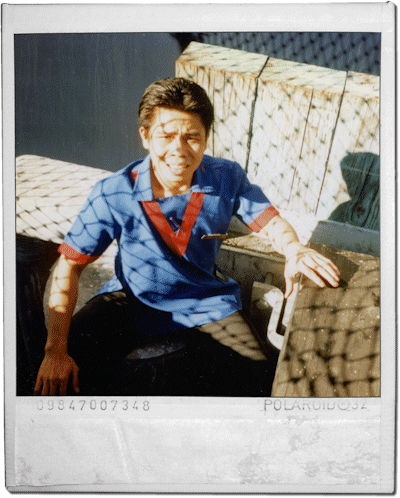
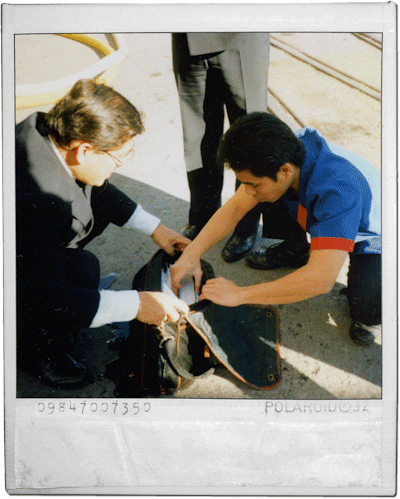
Inside that office several of the ship's crew had spread dripping-wet papers from my briefcase across every surface. People were on their hands and knees frantically trying to pat my stuff dry with towels. They looked up in unison when I entered the room. I could see panic in every set of eyes.

I broke out laughing. I said, "I told my wife I hoped that bag would fall in the ocean. You should have let it sink."

The panic in those eyes turned to pity. I think they all thought I was insane. The ship's purser, still grim, said, "Sir, I'm afraid everything in that bag is thoroughly soaked. It's very serious."

So I assured him it was not serious and tried to explain why this all struck me as hilariously funny. I also reassured the purser that I didn't need any kind of compensation or complimentary liquor for the week, or whatever. And I wasn't going to sue or demand free passage on cruises for the rest of my life.

I finally managed to convince them I really wasn't upset or crazy, and they breathed a collective sigh of relief that was almost palpable.


There was one woman in the room dressed in civilian clothes. She followed me out of the room and said, "Mr. Johnson, may I have a word with you?"

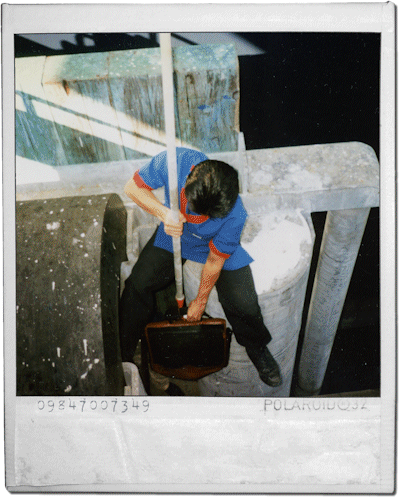
She said, "My name is Jeannette Seale. I'm on staff at the Seward Seaman's Mission, an evangelical mission to crew members on cruise ships. I was there when your bag fell in the water. I saw something fall; I heard the splash; and I heard crew members frantically shouting, No! No!" I thought a baby had fallen overboard or something.

"Two men crawled down the ship's ladder, literally risking their lives to retrieve your briefcase. They allowed me to come on the ship, because I knew the crew member who dropped the bag, and he was utterly distraught. He is a Muslim." (The ship's crew was from Indonesia.) "And he was saying, 'Oh God! Oh, God!' and I said, 'Amir, Allah is not going to help you now. We need to pray to Jesus. And I prayed aloud that whoever owned this bag would not be seriously angry. Because if you were angry or demanded compensation, it would probably cost him his job.

"Then," she said, "when we opened your bag, I could tell immediately from the contents that you were a Christian in full-time ministry. And then I began to pray for you, because I have seen too many Christians in situations like this behave worse than the world. And I thought if you lost your temper it would damage your testimony, and mine, and all the Christians on the ship.

"So I was profoundly relieved when you reacted the way you did, and I wanted to tell you thanks."


Now I'll be the first to admit that I'm no hero in circumstances like these. I have lost my temper and shamefully damaged my testimony in other, more trivial circumstances. Ask Darlene. I'm much too prone to mutter really unkind things about other drivers on the freeway. And she always admonishes me to try to speak in a kinder tone with customer-service reps on the phone. If you are a long-time blog-reader who has seen my responses to persistently-critical blog-comments, you know that sharp-tonguedness is one of my besetting sins. I admit it to my utter shame.

But this was different, because I immediately saw the hand of Providence in the whole incident. I had virtually prayed aloud that my bag would get dropped overboard. I had said to the bag, "Be thou removed, and be thou cast into the sea." It seemed clear to me that God had answered in a dramatic way. When the bag fell into Resurrection Bay less than 24 hours after my flippant comment to Darlene, I knew instantly that it was God Himself who gave it a push. (A crew member told me that in 20 years of working with that cruise line, he had never heard of a passenger's bag falling into the ocean.)

Fortunately Eddie Bauer bags are sturdy and well-sewn. Though by no means watertight, the bag floated just long enough for the crew to retrieve it before it sank. Their risky rescue operation was above and beyond the call of duty.

Subsequent events proved that the Lord had a good purpose for dropping my bag in the sea. There was a group of Indonesian Christians on the crew who always visited the Seward Seaman's Mission when their ship was in port, and when they heard what had happened, they invited me to come and preach at their worship service on the ship on Monday night. They work long hours every Sunday and Monday, and then at 11:00 Monday night, they have just one opportunity per week to hold a worship service. About 25 of them would meet together each week in the middle of the night in a partitioned section of the ship's large dining room. And they gave me and Darlene the rare privilege of worshiping with them.

Their worship and fellowship lasted well into the early morning hours—not because my sermon was long, but because they kept singing and praying and enjoying one another's fellowship until we all simply couldn't stay awake any longer. That late-night worship service was the highlight of the cruise for me. Indeed, it was one of the highlights of my life, like a little foretaste of heaven.

I have thought about this a lot in the ensuing years: All the trials we go through would be a whole lot easier to endure if we had more trust in the workings of Providence. If we would just bear in mind that God is fully in control of everything that happens to us—both "good" and "bad"—we would be far less frustrated, and far more confident that He is in charge, working all things (including the "bad" and merely inconvenient things) together for ultimate good.

By the way, the papers in that bag dried just fine. I answered every letter. Though wrinkled and covered with a layer of crystallized salt, they were all still readable. And each time I picked up the next letter and felt the salty texture, it made me smile. So even the work I had to do that week was a special, memorable joy.

Phil's signature

08 February 2010

Miracles and Acts of Providence

Whole lotta shakin'
There's a vast difference between God's constant providential control over the natural order of everyday events and His occasional miraculous intervention in worldly affairs. If you have difficulty understanding the diffference, here's a real-life illustration that I hope will help.

(First posted 11 November 2005)

Earthquakes!

etween April 1997 and April 2000, I lived through six earthquakes on four different continents. They were all fairly significant earthquakes that registered between 4.9 and 6.8 on the Richter scale—the kind that make you stop and gasp while you hold onto something for dear life. Falling frescoesBut they weren't really catastrophic events (unless you count the 6.8 quake at Assisi, in September of '97, which killed 10 people and destroyed some ancient frescoes on the ceiling of the Franciscan basilica there. That one struck within an hour after I had flown into Italy, while Carey Hardy and I were literally standing at our hotel's front desk, checking in.)

Here's the complete list, with documentation:


SIX BIG EARTHQUAKES THAT STRUCK CLOSE
TO ME AT THE END OF THE MILLENNIUM
Twin 5.0 quakes in southern CAApril 26 and 27, 1997
6.8 quake in Assisi, ItalySeptember 26, 1997
5.3 quake Hollister, CAAugust 12, 1998
5.1 quake near Queenstown, NZApril 24, 1999
5.1 quake near Pune, Maharashtra, IndiaMarch 12, 2000

The first two of those quakes hit within 24 hours of each other, while I was home. The others all occurred in places where I had gone to minister. The string of earthquakes in and of itself seemed a rather bizarre turn of providence. (An earthquake occurred every place I visited, practically every time I traveled overseas, for three years! What are the odds of that?) I admit that I wondered after the fourth and fifth quakes whether these tremors had some sort of apocalyptic significance, and whether they were meant to convey some divine message to me personally.

Falling frescoesIt also occurred to me that if I were a charismatic charlatan, I could have parlayed my connection with the earthquakes into big-time fame and credibility, simply by inventing whatever "prophetic" significance I wanted to imagine and claiming the earthquakes were divinely-inspired punctuation marks for my prophecies. After all, I had multiple witnesses to my presence in all six earthquakes. The one in Queenstown, New Zealand, occurred while I was preaching about Jonah, right after I had made an emphatic point about God's sovereignty over the forces of nature.

If you have spent any time in charismatic circles, you know that I could have easily sold the idea that the earthquakes were proof that I am endowed with amazing prophetic gifts.

As a matter of fact, the day before the Pune earthquake, an American faith-healing evangelist launched a series of open-air meetings in Pune, in a vacant lot across the street from where a friend of mine lives. This faith-healer was known for making prophecies of doom. He had preached in Pune a year earlier and prophesied a long series of catastrophic disasters that he said would devastate the region if people did not repent—earthquakes, floods, famines, etc.

Of course, if you make enough prophecies like that, chances are you're going to get one of them right (or close enough) someday. Since this guy's constant theme is disaster and he had already prophesied the full range of possible catastrophes (storms, earthquakes, financial disasters, and so on) the odds were pretty good he'd be able to claim something someday.

This earthquake hit the day after his first Pune meeting, so he immediately claimed the phenomenon was sent by God specifically as a fulfillment of his prophecies.

Now, this earthquake was by no means a disaster. It was enough to shake me out of a deep jet-lag-induced nap and into an immediate state of fervent prayer as the ceiling fan swayed over my head. It shook the whole city pretty hard. But it didn't really do any major property damage. As far as I know, no lives were lost.

My first thought, as soon as the shaking subsided, was, That guy is going to claim this as a fulfillment of his prophecies.

That is precisely what he did. That night more than 10,000 people showed up to hear this counterfeit prophet. They didn't notice the fact that no actual disaster occurred. The famines and financial disasters he had predicted never materialized. Even the earthquake itself was not really a disaster. But that fellow was claiming it as proof that he spoke for God, and multitudes believed him.

I happened to be visiting my friend across the street that night, and we moseyed over to hear the guy preach for a half hour or so. He was the worst kind of false prophet and charlatan, preaching a man-centered health-and-prosperity message to people the vast majority of whom lived in extreme poverty. And he took their money as a "seed-faith offering" that was supposed to make them rich. The amount of money he collected was astonishing. Then after prophesying more doom, he took a second offering.

He was preying on superstition for personal profit.

Superstition is irrational awe or fear of the unknown, resulting credulity regarding the supernatural. In this case, people's superstition was purposely manipulated and intensified by the preacher's deliberate blurring of any distinction between God's supernatural intervention by miracles and His providential control over everything that happens.

A miracle is a particular kind of sign—an unmistakable display of supernatural power calculated to confront unbelief and provoke awe—with the purpose of authenticating an agent of divine revelation. True miracles are not merely arbitrary displays of God's power; they are manifestly supernatural and are themselves a form of revelation.

The earthquake was a natural occurrence, not a "miracle." It had no more significance as a "fulfillment" of that false prophet's wild-eyed forecasts than it had as a harbinger of my presence in Pune. There was no reason whatsoever to see it as an example of immediate and preternatural intervention by God. There was no reason to assume it was a special judgment against the sins of the people in that city, as if they were worse sinners than the people in Calcutta (cf. Luke 13:1-5. As a matter of fact, there was far more evidence of mercy than judgment in the providential outworking of the Pune earthquake). The only reason anyone assumed otherwise was sheer superstition, aggravated by the claims of a man who was pretending to speak for God, even though he clearly did not.

By denying that there was any overt supernatural significance or special revelatory message from God in the earthquake, am I suggesting that God had no involvement in the event at all? Am I claiming it was without any meaning or significance whatsoever—as if it were a chance event, utterly devoid of divine purpose? Of course I am not saying that.

On the contrary, I would insist that God is always working through providence, so that every detail of everything that happens is part of His eternal plan and purpose—right down to "insignificant" details like the number of hairs on your head, or the falling of a sparrow (Matthew 10:29-30). It's not necessary to invent a "miraculous" explanation for every extraordinary turn of events in order to give God due credit for accomplishing His will in human affairs. In fact, it downgrades the biblical concept of miracles to imagine that everything unusual qualifies as a "miracle."

I am convinced by all the clear commands and best examples of Scripture that God would have us ordinarily seek an understanding of how His will and His purposes are being providentially fulfilled (insofar as such understanding is given to us at all) by seeking wisdom in the more sure Word of Scripture, rather than the declarations of uncredentialed modern "prophets" who (I think we all agree) often mistake their own imaginations for revelation from God.

That's true of ordinary and extraordinary providences alike. Miracles are a whole different category, and by definition, they are extremely rare events—even on the pages of Scripture.

If you mask the proper distinction between providence and miracles, you confuse things that ought to be clear—and such confusion always breeds superstition.

David Wayne, the JollyBlogger, has a post that makes this point well: "We reformed cessationists believe that God has ceased revelation, but He hasn't ceased upholding, directing, disposing and governing all creatures, actions and things. In other words, God is working in a mighty way at all times."

Adrian Warnock rejects any such distinction: "I honestly believe it is the cessationist who makes the supernatural/natural distinction too large. "For me, it really doesn't matter too much if God answers my prayer for the healing of Phil Johnson's allergic rhinitis by means of a new medication, his body just suddenly deciding one day no longer to exhibit such symptoms. . . , by miraculously changing something physically wrong with his white cells or by . . . taking Phil home to be with him and performing the ultimate miracle of healing. I just want Phil to be healed."

I appreciate the prayers and the well-wishes, and I agree that God's answer to Adrian's prayer (by sending rain that eliminated the high pollen counts) was just as much an answer to prayer as a miracle of healing would have been. I also agree that it would have likewise been an answer to prayer if God had called me home.

But it's still not precisely the same thing. Ask Darlene if the dead-Phil option and the natural-relief option are functionally equivalent in every sense, and she'll explain why they are not.

But here's the main point: The faith that sees the hand of God in the natural outworking of divine providence (and understands that God is sovereign over every detail of everything that happens) is not a lesser faith than the kind of belief that can only see God at work when He intervenes in spectacular, supernatural, and miraculous ways.

Falling frescoes

Phil's signature

09 July 2008

My Turn: This Is Where I've Been Lately

by Phil Johnson

. . . in which I rant about Apple, PCs, keyboards, and Best-Buy Geeks vs. Apple-Store "Geniuses"—expressing both appreciation and loathing for pretty much all of them.

o with a big wedding coming up in our family, and a huge deadline on a book project coming due for me, this is the worst possible time for me to have my annual computer meltdown. But it happened this weekend.


And yes, it was my iMac.

I'm not sure whether I have actually mentioned it on the blog or not, but over the past year I've switched to all Macs both at home and at the office. No more PCs for me, period. (Except I still have one old clunker that I use as a network hub and a place to park backup files.)

Darlene's computer is a MacBook. My primary tool at home is—or was until Saturday—an iMac with one of those gorgeous, monster 24-inch monitors. And I use a MacBook Pro at the office and on the road. For much of my work, I still need to use Windows-based software. That includes—especially—hours of word processing every day, which I still do mostly with a DOS-based version of WordPerfect. (Yeah, yeah. I know what you are going to say. Don't try to talk me out of it. I do know exactly what I am doing.)

I can run Windows in a virtual machine on the Macs, with VMWare Fusion, and everything works spiffily. (Which, of course, is all very relative when you are talking about Windows.) But the virtual Windows machines (VMs) normally run better than any PC I have ever owned. And the Mac hardware and software alike are an absolute joy and a breeze to use when they work right (which is usually). Best of all, next time I get a new Mac, I'll be able simply to copy the VM to the new computer and run all my Windows software without having to reinstall the programs and go through the tedious and unnecessarily complex task of getting all the program settings tweaked the way I like them. That alone will save me three full days every two years or so.

Near the end of May, however, I began to have intermittent problems with the big iMac. The first incident was a total disaster—resulting in one of my most disappointing and frustrating data losses ever. I had spent all day (8:00 AM—8:00 PM) on a Saturday in May, preparing the next day's message. (Saturday is the only day I have to prepare for preaching, because I'm technically a layman, and I do have a full-time job that doesn't include sermon prep as a duty I get paid for.) On that fateful Saturday, after I had completely finished writing my notes, before I had printed them out or backed them up, I decided to run a spell check. During the spell check, the whole VM crashed and flatly refused to run again. After hours of troubleshooting and desperately searching for the sector on my disk where some scrap of the sermon file was located, I had to re-load a backup copy of the VM, which, of course, prohibited me from ever recovering the lost sermon. (I had to re-preach an old sermon the next day, and I still haven't had the time or the heart to reconstruct the one I lost. Trust me though: it was probably my best sermon ever.)

So since May, the performance of the iMac had been gradually deteriorating. Mostly, it was annoying little things. It would stall for 3-4 seconds at a time—like a hiccup—and then get back to bidness. This was not a huge inconvenience (and no big deal at all for someone used to PCs). But it was annoying, especially after I had gotten used to the Mac's normal, smooth, nearly-perfect functionality. The errors I got were unpredictable and intermittent—gremlinlike. Mostly annoying, but (except for that first one) not really disastrous. I never had precisely the same kind of problem twice, and I never could make the same error recur again by any predictable sequence of specific actions. The only data I lost in those three months was that one sermon, but I did lose hours restoring corrupted files, reinstalling programs, re-copying from backups huge things like my iTunes library, and fastidiously backing up twice a day instead of once, just to be safe until I had some clue about what the specific problem might be.

Oh, and the disk diagnostic software kept reporting that everything was OK.

I could feel disaster breathing down my neck, but I had no clue what was causing it, and I was mostly considering software issues, assuming it was some rogue bit of code that was messing me up. To be honest, I had a sneaking suspicion it was a Windows problem, because the gremlins inevitably seemed to invade when the VM was running, and besides—I have never had a Windows machine that didn't have some kind of major failure about once a year. So I fiddled with Windows registry-repair programs and whatnot, and prayed that I would stumble on a solution to whatever ailed my computer.

This past weekend was an important one for me. I had a long list of must-do things, at the top of which was more sermon preparation. Not run-of-the-mill sermon prep; I've been preaching in the main services at our church these past three weeks while John MacArthur is out of town, and I have been doing a 3-part series on Ephesians 2. So this time I did not have the option of re-preaching something old, because I needed to finish that series. It was not a good time for my computer to go bad.

But almost as if on cue, the computer crashed and died completely at noon Saturday. It wouldn't reboot. It just stared at me with this interminable, totally-blue screen, devoid of cursor, command-line, and error message alike.

I tried to take this in stride. I had recently backed up a draft of my notes to an external hard drive. So I moved that to the MacBook Pro and and kept working on the sermon notes with one hand whilst trying to reinstall Leopard on the iMac with the other. The MacBook Pro is a very nice laptop, except for the spongy keyboard, which in my experience misses a letter every third word or so, making it necessary to do a tedious re-read every time I finish a paragraph. I hate that keyboard, and therefore I never use the laptop for any important writing or word-processing if I can avoid it.

Anyway, I finished both the sermon and the OS-reload at 4:00 AM, preached at 8:30 and 10:30 AM, and then came back home after church planning to boot my computer and try to assess what had been causing it to crash—only to find it would not boot at all. I tried five different ways to re-load the OS, and finally wiped the disk clean and left it reinstalling the OS when I went to bed Sunday night.

Monday morning, with a clean install of OS-X and no data or anything else on the computer, the beast still wouldn't run consistently. The screen looked right, but if I clicked the mouse on any menu item, I would get the spinning-beachball thingy (Mac's equivalent of Windows' dreaded hourglass cursor), and the beachball would spin tauntingly for 3-5 minutes every time. I rebooted, and again the computer gave me the permanent blue screen.

So I called Apple support. I ended up talking to an extremely polite, very knowledgeable, and refreshingly helpful young guy in the Philippines. After stepping me through some diagnostics, he confirmed what I knew by now anyway: the hard disk was toast, and I needed to take it to the Apple Store for repair. He even made me an appointment to meet with a Mac "Genius" at 2:00 PM that day. It was only 7:30 AM when I got off the phone with Manila, but 2:00 was the earliest available appointment.

Now here's what I really, really hate about Apple: The ridiculous appointment system in their stores that keeps you from getting a speedy answer to even the simplest of questions. My absolute contempt for the inflexible protocols of "customer service" at Apple's retail stores ranks right up there with my scorn for Windows' registry. (And there are numerous parallels between those two evil systems.)

All I needed to know was approximately how long it was going to take to get the hard-disk replaced in my iMac. A reasonable question, right? (Because if it was going to be a week or more, I would very speedily need to acquire some new hardware to trick out my laptop so that I'm not dealing with the spongy Swiss-cheese lameness of the MacBook's toy keyboard.) So I phoned the Apple store and discovered it's utterly impossible to get a live person on the phone system. You're given many options after listening to a half hour of generic recorded messages (starting with ads! On my dime? arrgh.), but talking to a human is not one of the options. So I drove over to the Apple Store in Canoga Park just in time for their 10:00 opening, thinking I could probably ask one of the "Geniuses" a simple question such as that, and if necessary, buy myself a new external keyboard and monitor by noon Monday.

Silly me. There is absolutely no way to get a question like that answered without an appointment. Three very cheerful "greeters" assured me that I would have to wait till my 2:00 appointment to get my answer. (Greeters? I don't know their official designation, but I'm talking about the sub-geniuses whose job seems to be to stand at the door and intercept people coming in—mainly to try to get them to make appointments with salespeople and/or actual Geniuses.) The perpetually-smiling phalanx of greeters assured me they themselves are not authorized to answer any questions about Apple service or product details. Their one area of speciality, it seems, is getting people signed up for appointments. Since I already had an appointment, arranged by a phone-support guy in the Philippines, they couldn't really help me.

See you at 2:00.

I drove away thinking of the irony that Apple's most famous ever ad campaign portrayed them as the antithesis of mindless Orwellian regimentation, but somehow, it seems, Big Brother has written the rules of their customer service.

So I had an early lunch, drove to Best Buy, and browsed there for an hour or two. I actually felt a wistful longing for those halcyon PC days when I could walk unannounced into any Best Buy, grab a member of the Geek Squad, ask any question I liked, and usually get a fairly reliable answer—without having to fight my way through a bunch of door-Nazis and a thick web of red tape for the privilege of 3 minutes' time at the "Genius Bar."

Back at the Apple Store, 3 minutes was literally all I needed with a Genius. He punched up the incident report from the guy in Manila, took my iMac (unpacking it from the original packing box, which I had carefully preserved in pristine shape), gave me the empty box (except for the styrofoam), handed me a receipt, and took my iMac off to surgery. He tells me the replacement part is in the store already, but my machine has to wait in the queue for its repairs, so I won't get it back till the end of the week.


In the midst of all this, I purchased a new external keyboard for the MacBook, and I am absolutely thrilled with it. It's a Unicomp Space Saver with the classic buckling-spring key mechanism. (I ordered it from Unicomp and paid extra for expedited shipping.) Not cheap, because this is no featherweight piece of hardware. But I needed it badly, and fast.

In terms of looks, The Unicomp keyboard is at the opposite end of the scale from the sleek, paper-thin Mac chiclet-key beauty I had on the iMac. That one was stunningly stylish but horribly inept at registering keystrokes. I had nicknamed the Apple keyboard "Jezebel" for its beautiful malevolence. It wasn't quite as diabolical as "The Abomination of Desolation" (my name for the built-in keyboard on the MacBook)—but it came really, really close.


OK, the Unicomp keyboard looks like a refugee from the 1980s—and it actually is. It's a replica of the old IBM classics, with the same kind of mechanism inside (a real spring, not a squidgy rubber diaphragm). It is uglier than an old Winnebago, but for sheer typing comfort and accuracy it is the best, most well-fitting keyboard I have ever owned. It never misses a keystroke; its touch is light as a feather; and it makes a very pleasing "click" when the little spring inside each key buckles. I already like it way better than any keyboard I have ever used, and I have decided that I will never, ever again buy a keyboard whose major selling point is that it looks cool.

If you have never used a buckling-spring keyboard, you don't know what you are missing. The original 1982 IBM-PCs came with them standard, and I remember thinking the keyboard was the best thing about the whole computer. (I had previously owned an NEC-PC, which had a really frustrating keyboard that simply could not keep up with my typing speed, and trust me: I am no Mavis Beacon.) I loved my original IBM-PC keyboard, but by the late 1980s, I had moved to PC clones, and when Windows debuted, you needed a whole different kind of keyboard with more keys, and no one made the IBM-style mechanical keys standard, because it was too expensive. So without deliberately making the move, I had gravitated by default away from buckling-spring keys along with the rest of the PC world. Never again did own a computer whose best feature was its keyboard. The opposite was usually the case.

Since getting my iMac last June, I had gone through 3 different keyboards, starting with the big white wireless one that came with my iMac—cool looking, but utterly worthless. And even the cool looks were short-lived. It soon filled with crumbs and dust that you could see through the clear plastic casing, and there was no obvious way to clean it. It also went through batteries like a kid eating M&Ms. I finally gave up on the wireless and bought one of those sleek, wafer-thin new ones with a hard-wired USB attachment. It was worse than the wireless one.

My frustration with Apple's keyboards got me longing for those old IBM keyboards, and I came across some web-articles touting the virtues of buckling-spring keyboards. That led me to Unicomp, who makes exact replicas of IBM's vaunted Model M keyboards. They seemed pricey, but after using one, I hafta say: they would be worth twice the price. And though it is technically a PC keyboard without any of the peculiarities of Mac's key placement, I actually prefer that, and it works perfectly with the Mac. (The Windows key functions as Mac's "command" key.) Plus, the life expectancy of these keyboards is more than three times that of the average off-the-shelf plug 'n' play special.

Finally finding a keyboard that works so well almost makes the iMac's disk meltdown seem like it was worth it. Plus, when my iMac comes back with a new disk, I know it'll take about 90 minutes to restore everything from Apple's Time Machine backup, as opposed to the three days it would take to recover from a fatal PC disk crash. And I'm actually relieved to know that the problem with my Mac was hardware and easily fixable rather than a software issue I might never sort out. So aside from the many hours this catastrophe has cost me since May, I'm a pretty happy camper, and I'll be even happier when I get my iMac back and it's working.

But meanwhile I have a lot of catching up to do.

Phil's signature

17 October 2007

As Good as It Gets

posted by Phil Johnson

arely do I put sound files on the blog, so when I do, you know it's a good one. You've got to hear this.


The sound clip linked below was recorded last Saturday (thanks to Bill Fickett). It's from KFI 640 ("More stimulating talk radio"). That's a secular all-talk station and probably the largest Clear Channel radio station on the West Coast—not a source where you'd normally expect to hear a lesson about divine providence. But it's a good one.

Some facts about this story before you listen:

  1. Johnny MacArthur is John MacArthur's eldest grandson. He's a high-school senior this year and a scratch golfer with a full-ride golf scholarship to Pepperdine next year.
  2. Johnny is a senior, playing football for the first time in his high-school career. Of course, many well-meaning friends and conservative grown-ups advised him not to go out for football because of the risk of an injury that could jeopardize his scholarship. He tried out and made the team anyway.
  3. Hart and Canyon High Schools have one of the fiercest rivalries ever in US high-school football. Johnny plays for Hart High School. Canyon was last year's state champ in football. (Canyon's stadium is down the hill from my back yard. I hear their marching band practicing in the mornings. Hart, across the valley, is this community's oldest high school, named for William S. Hart, an early cowboy actor, who founded the Western film studios that originally built this community.)
  4. I suppose many Pyro readers will have heard about the terrible truck accident that occurred in the Newhall Pass on I-5 Friday night. It made national news and Fred Butler blogged about it. The accident site is also close by my house. (In fact, a straight line from Canyon's football stadium to the truck accident would intersect my house.)
So anyway, here's the sound file. Listen to that clip first (and stay with it all the way to the end), lest the ending be spoiled for you. But then here's a video of the key moment in the football game. Phil's signature