<body><script type="text/javascript"> function setAttributeOnload(object, attribute, val) { if(window.addEventListener) { window.addEventListener("load", function(){ object[attribute] = val; }, false); } else { window.attachEvent('onload', function(){ object[attribute] = val; }); } } </script> <iframe src="http://www.blogger.com/navbar.g?targetBlogID=21212024&amp;blogName=Pyromaniacs&amp;publishMode=PUBLISH_MODE_BLOGSPOT&amp;navbarType=BLACK&amp;layoutType=CLASSIC&amp;homepageUrl=http%3A%2F%2Fteampyro.blogspot.com%2F&amp;blogLocale=en_US&amp;searchRoot=http%3A%2F%2Fteampyro.blogspot.com%2Fsearch" marginwidth="0" marginheight="0" scrolling="no" frameborder="0" height="30px" width="100%" id="navbar-iframe" title="Blogger Navigation and Search"></iframe> <div></div>

31 March 2007

New Post

Intuition and Superstition: An Admonition

by Phil Johnson

veryone has unexplained thoughts that seem to leap from nowhere into the mind. (Note: When I say "everyone," I mean believers and unbelievers alike; I don't necessarily mean "every single individual." I've met a few less-than-completely sentient people who seem incapable of any original thought whatsoever. They prolly never get spontaneous notions of anything. Let's leave those folks out of this discussion.)


Most people likewise have a sense of intuition, where at times you just feel like you know a thing is true and you can't give an account for how you arrived at that knowledge rationally. It may even seem like you have ESP, or ESPN2, or whatever. It's a lot like deja vu, only backwards. I happen to think that sense of intuition is probably more rational than we can explain. In any case, I'm quite sure it's not really a supernatural spiritual gift from God, because it has such a poor track record. Besides, I had the same intuitive abilities before I was converted as I have now.

My sense of intuition is sort of like a stopped clock that was designed to measure time in months instead of hours. Once or twice a year (on average) it's right. And when it's right, it can seem quite impressive. I've had some moments of intuition that I could have parlayed into a fortune, if I were the type of charlatan who is willing to claim he has a prophetic gift even when he knows he really doesn't. I certainly have no such gift. For the most part, my intuition is grossly fallible and ordinarily wrong. I don't trust it at all, even though my experience is probably a lot like yours: there are times when I feel compelled to follow my intuition.

To be clear: I usually "feel compelled to follow" my intuition only when I don't have a better rational or sensible idea of what to do. Maturity has taught me to hold off on trusting intuition and try to understand facts and reasons and the potential results of my actions before I act. In fact, I'd say that's what maturity is all about, to a very large degree.

But, how do we understand that inner sense, especially when God seems to use it to prompt us to pray, or witness, or duck and run at precisely the right moment? Because let's be honest, here: that kind of thing does happen to most of us from time to time.

As I said in a comment-thread a couple of days ago (see below), we need to regard those occasions as remarkable Providences, not inspired prophecy. God might use a spontaneous thought in my head providentially. In fact, as a Calvinist, I don't hesitate to say that He ultimately controls and uses everything providentially. But that's as true of my sins as it is of the thoughts in my head. God can use them all for His own purposes. The fact that He uses an idea in my mind to achieve some good purpose doesn't make the idea itself inspired.

That's the point we are trying to make in all these various threads about prophecy and cessationism. It's an important point. We're not trying to step on the charismatic air-hose just because it's fun.

So please give these things some serious thought before you react this time.

Four lessons:

  1. If intuition is fallible (and everyone except the out-and-out-charlatan seems to agree that it is), it cannot be considered "revelation," even when it happens to be uncannily right in an instance or two.

  2. Since intuition is so fallible—and most would agree that it is actually far more often wrong than right—we shouldn't make much of it.

  3. Those who think those moments of intuition are God speaking with a private message invariably become extremely superstitious; they foolishly order their lives by their feelings; they commit the sin of trusting too much in their own hearts; and they diminish the more sure Word of prophecy. No one who knows church history, and no one who truly understands the concept of spiritual maturity can deny that Christians who follow the voice in their heads fall into those errors all the time, and it can be (and often is) spiritually disastrous.

  4. Since our intuitive sense is so grossly fallible, and since every sane, biblical Christian would acknowledge that it's dangerous to pay much attention to it, we should not try to elevate it to the level of a supernatural "spiritual gift." It most certainly does not resemble any of the spiritual gifts—much less the gift of "prophecy"—as we see those gifts functioning in the New Testament.


Phil's signature

Here's that comment I made in the meta below:

I'm tied up with meetings today and unable to participate in the blog-discussion, but a couple of people have e-mailed me privately with the same question about this thread. One begged me for an answer; the other accused me of dodging the question.

So here's the question and my short answer:

Q: If God doesn't speak to you directly, how does he "lead" you to do anything? How, for example, did you know Darlene was the right person to marry?; how did you know you were called to ministry?; and how do you explain it when a thought pops into your head and prompts you to pray for someone?

Short answer: I trust the providence of God. I can't necessarily interpret the providence of God infallibly, though.

So if (for example) I suddenly think to pray for the safety or holiness of one of my children, I don't need to interpret that as a prophetic message from God that Pecadillo or one of his brothers is in immediate danger. But I pray for them nonetheless, though I can't possibly understand why that thought popped into my head or even discern correctly whether it originated in my own imagination or was immediately infused into my brain by the Holy Spirit.

If it turns out later that I prayed at exactly the right moment when some specific danger befell one of my kids, I praise God for a remarkable providence.

I DON'T, however, twist it into some kind of quasi-revelation and use it as an excuse to trust my own heart. Scripture says those who do that are fools (Proverbs 28:26).

Here's the thing: I trust Providence enough to believe that God ordained that I should pray, and He will answer my prayer for His glory and my good, even if the thought that prompted the prayer was out of my own imagination.

But it would be a sin for me to claim God "told" me to pray about that particular thing at that particular time when He did no such thing.

Providence, people. Go and learn what that means, and we can avoid having this debate every 6 weeks or so.

Here's a book, written by a good friend of mine, that deals with this issue well.

Phil's signature

11:45 AM, March 29, 2007


Labels: , ,

30 March 2007

New Post

Thanks for the sermon prep!

by Dan Phillips

We've done a few studies in Proverbs, you and I, here at Pyro. There was a three-part series (starting here), and a one-off (here).

I was recently invited to preach at my church. Since I never turn down an invitation if I can help it, I grabbed it. Then I reflected on what to preach.

As I've been asked to be keynote speaker at a Bible conference, and plan to speak on Proverbs, that book seemed a natural selection. As much as I love it, and have written and taught on it, I haven't really preached on it. So Proverbs was the general field, and Proverbs 3:5-6 was the focus I ended up selecting.

You helped with the preparation. Earlier this month I solicited from you horror stories in the misapplication of Proverbs 3:5-6, to assist me in preparing for that sermon. You responded very helpfully, and I used it in my sermon. Thanks!

You can hear the results, if you like. The title is What God Means by “Trust” (from a misunderstood text).

What you maybe can't hear so well is that a little baby evidently was also enjoying the fellowship, with some gusto. At one point he (she? sorry, mom and dad) let out with a mighty whoop. It might even have been ecstatic. It worked into the sermon, also.

Also, I always give out an outline, sometimes (as in this case) with my own translation of the passage we're studying. You can get the outline here.

Dan Phillips's signature

Labels: , ,

New Post

Down a notch

by Frank "stats" Turk


That's a screen shot of the top 5 referrers to Team Pyro, and it says two things to me:

[1] Most of you have bookmarked this page, which is amazing, and

[2] Most of the rest of you have used a search engine (Google) to find us or something we have said. Wow.

So because I'm curious like that, I made our Google Analytics give me a list of the top search items which brought you to TeamPyro. Here's the top of that list:


So for example, somehow "adultery" managed to be the #16 most frequent search term which drove people to TeamPyro. huh. It pleases me that "schmeradactyl" beat it out in frequency ...

But as you scroll through that list -- and this is only from visitors in the last 7 days -- you see that the Francis Chan video is still getting play. Listen: give it a rest. Let's argue about something we can all agree is wrong, like the contemporary obsession with the Gifts, and get on with our lives.

And be in the Lord's house on the Lord's day with the Lord's people. Even if they start speaking in tongues. Just don't let anyone prophecy to you with the caveat, "If I heard the Lord correctly."


Labels: , ,

29 March 2007

New Post

More on Reading

by Frank Turk

While this is likely to get bumped for the sake of further active theological aggression against Continualists, I just wanted to say a little more about how we read Scripture -- or rather, I wanted to point you to a recent podcast that was a stand-alone gem.

Personally, I run hot and cold on the White Horse Inn. I think Michael Horton and his associates are a little strident and facile, and they have some chatty Cathy tracks that if you listen long enough will probably make you a little, um, grumpy, but then again look who's talking. You could say that about me, I am sure.

At any rate, we've been talking about how to read Scripture, and lo and behold: they gave up 00:37:19 on this very subject last week. I think they made excellent -- top shelf -- comments on the topic as a good primer to those who are trying to figure out, "yeah, but how do you read the Bible?"

I have staged it for easy access at archive.org here.

And here's the bonus: your don't have to worry about whether or not this is the voice of God. It's not. It's just good and Godly advice from some men who have thought about this well.

Back to your regularly scheduled shrill discourse ...


Labels: , ,

28 March 2007

New Post

The Amazing Dr. von Cipher's "Conversation" with "God"

by Dan Phillips

Yes, indeed: why should Frank and Phil have all the fun?

Bypassing for the moment the beloved physician and Dr. Piper, I'd like to focus on the fountainhead article: My Conversation with God, in Christianity Astray Today, by that bold, lionhearted professor... Anonymous.

I'm surprised nobody has accused me of paying Dr. von Cipher for illustrating virtually every point I've ever made about the leaky-Canon set. Let's see, what do we have here?

Anonymity. We are supposed to accept his anonymity right off the bat, and keep reading with respect, openness, and interest. But should we?

The Bible says, "The wicked flee when no one pursues, but the righteous are bold as a lion" (Proverbs 28:1).

Our erstwhile prophet says, "I can only [testify personally to hearing God's extra-canonical voice] anonymously, for reasons I hope will be clear."

Um... yeah. Maybe they are clear.

I guess maybe some parents might feel a tad uneasy if they knew one of their kids' profs was hearing voices which he felt compelled to obey? Or adults might save their money, if they learned that one of their professors did not really believe that the Scripture was sufficient? Or the trustees, or the department head, might be uneasy about continuing to employ a man who felt equally morally bound to obey internal voices as the Word of God on occasion.

If he were honest about it, about his rubber-meeting-the-road beliefs, it might cost him his job or something, I guess. Meanwhile, better to let all the folks who trust him and trust their kids (or money) to him think that he is something other than what he really is.

It's hard to think why the writer feels he must maintain this anonymity — or at least hard to think of a charitable reason. Christians don't kill Christians for having different doctrine these days. Heck, we can barely bring ourselves to have a decent argument with each other! If we even try, we're called "judgmental," "unloving" — "shrill," even.

This man isn't a Muslim professing Christ, likely to bring horrible torture and death on himself and his family. Further, the leaky-Canon position is all the rage today; if he's such a famous author, surely some "love-that-Bible-,-but" school would snap him right up. If he lost his job, he'd be a hero!

What good motive are we all to attach — as he invites us to do — to his secrecy?

God made him write a book. Again and again, those poor souls desperate to save modern revelatory counterfeits assure us that their notion of "prophecy" does not threaten the Canon. God won't be writing any books through them, they insist. The Bible is safe and inviolate.

Yet read what this man would have us believe (emphases mine):
The next week, I was at the same spot in my morning exercise when something amazing happened. Out of the blue, a book title came to me. It was so clever I knew two things instantly: It wasn't mine, and it would sell.

Then, in almost the same instant, the entire outline of the book was there in my mind. Every chapter and its title. No discursive thought preceded it. I immediately went home and began writing. As I wrote, I had the distinct feeling that this was not me. I had never written like this before. The words poured out. Two weeks later, a 200-page manuscript sat on my desk. I knew it was good.

Well, I guess so! It would have to be good! He got it by inspiration of the Holy Spirit!

"Whoa, whoa there, wait just a minute. He didn't say that," a modern enabler might object.

He didn't? Do words mean things, anymore? Are we supposed to believe what he tells us? What he tells us is that this book title "came" to him "out of the blue," and he knew instantly "It wasn't mine." It wasn't? Then whose was it? And whence did it come? "No discursive thought preceded it," he insists, thus most plainly telling us the source was not his own mind. Would it be going too far to re-phrase him as asserting that his book did not come from his own interpretation, nor was produced by his own will?
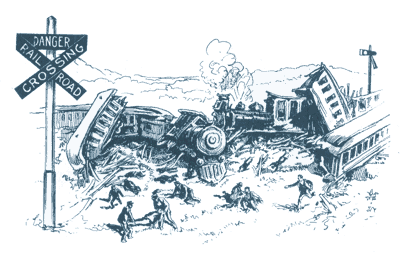
Read 2 Peter 1:20-21, and tell me what this describes.

He's a theology professor. He knows what he's claiming — or he'd better darned well.

Now, a pagan would say, "Oh yes, this is a well-known phenomenon. It's called 'automatic writing.'" But the writer is not a pagan. He's a Christian, writing to Christians. Clearly, we're meant to believe this book was "given by inspiration of God," as the phrase goes. (And the proof is that he got a lot of money for it. Hey, don't look at me like that — read the article!)

So, if it came from God, as Dr. Braveheart clearly wants us to believe — how much of it came from God? Was it 14%? 39%? 87%? 99.732%? 100%? How much?

Those welded to the charismatic tradition hate it when I use the phrases "leaky canon" and "low-octane, semi-hemi-demi-revelation" — but you tell me what this is supposed to mean, if it's supposed to mean anything.

Don't bother. I'll tell you: it is supposed to mean that God imparted new, unmediated, verbal revelation to this man.

Again, read the article: "Then God spoke: It's not your money.'" That is a direct quotation, purportedly from God. Just like Isaiah and Jeremiah and any prophet proclaiming koh 'amar Yahweh ("thus says the LORD"), so this man tells us exactly what God says, verbatim.

So, were those God's exact words? Wow, that's really something.

Now, just reflect on that earth-shaking claim for a moment. This is the selfsame God who spoke the Ten Commandments, Isaiah 40, Psalm 23; the God who most recently was seen breathing out Romans, Hebrews, Revelation.

And now He parts the curtain once again, after two thousand years of silence as to fresh revelation, to give direct, unmediated, verbal inspiration — and what He has to say is:
"It's not your money."
Oh. Huh. Wow. Well...em...not exactly Romans 8, is it?

But "God" wasn't done. (I won't put "God" in quotation-marks throughout; mentally supply them, please.) Our man isn't brave enough to tell everyone his name, but he is brave enough (on his own admission) to argue with God, to demand an explanation of Him. (Mercy; if only Job, Peter, Isaiah had known it was so easy and casual to speak to God in this way!)

God replies, "It's not your money. It's his."

Now, that's funny, too. If God wanted to say it was His money, this would be no great news. It is all His, every last bit. We know that from the Bible (Psalm 50:10; Haggai 2:8, etc.).

But it is passing odd for Him to say the money belongs to someone else — after He'd made such a point about personal possession and rights of private property (see commandments ##8 and 10). Has He, well, you know...changed His mind? (I speak as a very-leaky canoneer.)
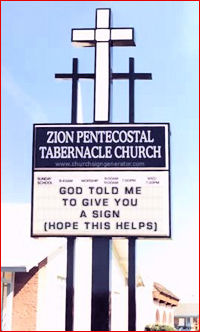
I guess that's why it took fresh, unmediated revelation. The Bible never would have told him this.

And that whole thing is odd, isn't it? The man imagines that he's got God's ear, and he wants to quibble about royalties? Two thousands years of silence broken, and this is the topic?

Why didn't he ask God for something quotable on baptism, or eschatology, or what happens to infants when they die? Why not ask Him for the exact exegesis of Romans 5:12? Or 1 Corinthians 13:8-10? (Wouldn't it have been funny if God had told him it meant that revelatory gifts would cease with the close of the Canon? What a conundrum! But I digress.) Or the meaning of "Parbar"? Or what God's favorite Bible translation is?

The Deepest Concern. But wait, there's more. And I think this may be the most table-poundingly important aspect of the whole thing.

Charismatics like to (evade responsibility for their claims and) insist that what they experience is not high-octane, canonical-level revelation. It's just a fun little intimacy they share with God. No cause for alarm. Put away the big guns. Nothing to see here.

Uh-huh. Well, we've already seen that that doesn't quite work out. But check out this interchange, in which Dr. von Cipher is arguing with God about giving all his royalties to the prospective student. We resume the "conversation" in progress, adding emphases:

"All of it?"

"That and the rest."

I knew "the rest" meant any further royalties the book might earn after it was published.

Absolutely flabbergasted, I raised my fist in the air and asked aloud, "What about my roof?"

The voice said, "I'll take care of your roof, if you'll be obedient."

Then I said, "If you want to use me to help him go to the university, why not give me everything it will cost? Why this amount that will make a difference but not pay his whole way?"

"Others have to be obedient, too," I heard in reply.

First, the smaller point: he "raise[s his] fist in the air." The sinless, perfect, burning seraphs cover their eyes and feet before the glory of Yahweh (Isaiah 6); prophets and saints fall on their faces and beg for mercy, expecting to die instantly. But the impact that a visit from God has on this man is... well, it ticks him off. Brave before God, not so much before men. Prophets and apostles and angels in glory shake their heads in astonishment.

Now, the greater point: "OBEDIENT." Said twice.

"Obedient" speaks of moral obligation. It is a binding of the conscience and will. It is a narrow road. Obey, and you do righteousness. You please God. Disobey, and you sin. You invite the judgment of God.

Obedience is a wonderful and essential Christian grace (John 14:15; 15:14, etc.), and its opposite is an appalling offense. "Has the LORD as great delight in burnt offerings and sacrifices, as in obeying the voice of the LORD? Behold, to obey is better than sacrifice, and to listen than the fat of rams. 23 For rebellion is as the sin of divination, and presumption is as iniquity and idolatry" (1 Samuel 15:22-23a).

But nota bene: the man is speaking of obedience, not to a Biblical command such as "Do not commit murder," "Do not commit adultery," "Love Yahweh your God with all your heart...", or "Husbands, love your wives."

He is speaking of obedience to a voice in his head.

Think about it. Now, please think this through soberly and as Christian adults. What do we have here? We have two momentous claims: (1) the claim of a book authored by God Himself, and (2) quotable verbal revelation with absolute binding moral authority.

What is a nine-letter word for that kind of revelation? I'll give you a hint: it starts with a "C."

The man then reveals this revelation to his wife, who (go figure) was kind of looking forward to fixing the leaky roof. But he tells us that she "is more spiritual than I am." Lucky thing for him, that. The roof is going to have to wait, because he's had a direct, verbal revelation of the morally-binding will of God, and she must obey too.

If our hooded brother had wanted to write an anonymous article about how he had felt moved — by Christian love and generosity, voluntarily, and according to a personal application of Biblical principles — to give his royalties to a struggling young student, that would have been one thing. We would easily have understood the anonymity as being Christian modesty and reluctance to toot his own horn. We would have understood the point of the story as being that we should maybe live out the values of the early church, in thinking of how we can invest in others. There could have been a lot of positive value in the story, and no argument whatever. We'd have admired him, and felt challenged to emulate his example.

But that isn't what the story was about, it isn't why it was written, it isn't the impact it is meant to have.

Look, I could go on and on and on, and it wouldn't get one bit prettier.

This is the foundation. Tomorrow, Lord willing, some (far briefer) reflections on the whole.

AFTERWORD: I am aware that this is a blisteringly scathing essay. What possible justification is there, for this tone?

Because our Lord Jesus, and His apostles and prophets, were always the most unsparing and ferocious with false teachers and religious leaders.

Because the issues are huge, though they're being dealt out as if this were a playground conversation.

Because I feel deeply concerned for all the people who you and I know darned well will read an article like this, envy this man's (purported) intimacy with God, and start listening for voices in their head, too. And they'll start heeding those voices, even if (as in this case) they don't quite jibe with the Bible.

And what kind of Christ-shaming, damaging, ruinous behavior will come of that?

You want to resent me, be mad at me, rake me over the coals? Go for it.

Because I'm laying it all right out here before you. I'm not hiding behind a claim to private revelation.

And, by God, I'm signing my name to what I'm telling you.

Dan Phillips's signature

Labels: , , , ,

27 March 2007

New Post

Ecstasy

by Phil Johnson

hort post here. Read fast, because it's going to get bumped right away.

While we are on the subject of the charismata, I want to point out one glaring difference between contemporary charismatic experiences and the authentic apostolic gifts: In the New Testament, the gifts' most prominent feature was a ministry purpose that was extrinsic to the gifted person and his or her feelings: "that the church may receive edification" (1 Corinthians 14:5). That's precisely why tongues were always supposed to be translated so people could understand.

Listen to contemporary charismatics describe their experiences, however, and they'll invariably stress the issue of "emotions": fervor, feeling, joy, and related passions that they themselves feel. What they usually have in mind is a sense of ecstasy.

Charismatics' narrations of their tongues-experiences, for example, always seem to include an ecstatic element. (Glossolalia is often referred to as "ecstatic speech.") And listen, for example, to our friend Dr. Warnock's response to John Piper's "The Morning I Heard the Voice of God,": He says, "I want to EXPERIENCE personally the Spirit doing this much more frequently in a way that is as thrilling as the way in which Piper describes it."

The thrill is the real thing, evidently.

I don't see any "thrill" ever associated with exercising the gift of tongues or prophecy in the New Testament. Ecstatic passions certainly weren't the most prominent aspect of the experience. Rather, what stands out in Luke's description of Pentecost is that the languages spoken communicated a clear message that was perfectly understandable and powerful as to its content. Whatever emotional impact was registered was related to the message the listeners heard, not the feeling the tongues-speakers felt.

Likewise, when God's Word communicates to us in the way Dr. Piper was describing, it may not always be a "thrill." More likely, it's going to be one of the profound passions David describes in the psalms—ranging from profound assurance to righteous indignation to heartfelt sorrow to breathless wonder to angry exasperation—and sometimes even producing raw depression. Of course, Scripture also fills us with a sense of triumph, or encouragement, or hopefulness, or confidence—and always with conviction.

It's not only—or even mainly—about the thrill of ecstasy.

Phil's signature

Labels: , ,

New Post

Emotions? Sure. We got 'em. . .

by Phil Johnson

y cessationist convictions are no secret, although I have tried hard to stay out of debates about that subject here. But to reiterate: I don't believe the charismata are functioning today in any way that looks remotely like the apostolic gifts described in the New Testament. Benny Hinn's "miracles" don't bear the slightest resemblance to apostolic signs and wonders.

I consider cessationism a secondary issue, however, and it's certainly not something I'm interested in arguing about ad infinitum. So it's not a matter we like to bring up deliberately here on the blog. Carefully check the archives of this blog and its predecessor, and you will discover that when the subject comes up, it's usually at the prompting of our charismatic antagonists.

Like yesterday.

Nevertheless, I've been accused at times of "charismatic-bating." Truthfully, I think all of us Pyros would really prefer to steer clear of the issue completely (including Dan, if the facts were known), but it seems we can't even post on tangentially related topics without having charismatics crawling out of the woodwork spoiling for a fight. Even then, we do try hard not to be "shrill" about this subject. We love our charismatic friends—especially those who share our love for Scripture and sound doctrine.

As a matter of fact, last week within hours after John Piper posted his essay "The Morning I Heard the Voice of God," I linked to it in my "Where I am Right Now" column with this notation: "John Piper heard God speak! And I know this is true, because I got the same message!"

Frank Turk likewise linked to Piper's article a few hours later, as an addendum to last Wednesday's post, with a "Must Read" notation.

Later that evening, the esteemed Brit-blogger Dr. Adrian Warnock wrote to challenge us to respond to Piper's article. I assumed he had not noticed our links, and I pointed out that we had already double-linked the article with positive notices. Not satisfied, Dr. Warnock wrote to urge us to undertake a fuller dissection of the article and reply to his thoughts about it.

I was about to decline politely when Frank said he would take the assignment. Two or three days ago, Frank posted his draft in a secret place where Dan and I could preview it, proofread it, and make suggestions. We all agreed on the perspective Frank's article expressed. I especially thought he had done a good job (certainly a better job than I would have) at not sounding "shrill."

So much for good intentions.


So, since we've already ruffled charismatic feathers again, I thought I'd make this one more post with a personal perspective on the "cessationist" issue, and then I'm through. I really don't want to have to deal with this issue again every other month. It's not a new issue for me. I've studied it very thoroughly, and my position hasn't changed for more than 30 years, even though I've heard all the arguments and read all the books on the issue (and even edited some of them).

I want to give a word of personal testimony about why my position is so firm.

But first, here's some background material for those coming to this debate fresh:

Other Key Posts Where I have Dealt (usually under duress) With the Cessationism Issue


Now, here's why (even though I liked that article last week) I disagree with John Piper regarding the "gift of prophecy":

Piper's view is that New Testament "prophecy" is "prompted and sustained by the Holy Spirit and yet is fallible." (See Frank Turk's discussion of this issue at his blog yesterday.) That is essentially the same view defended by Wayne Grudem in The Gift of Prophecy in the New Testament and Today.

Quite simply, the view contradicts Deuteronomy 18:21-22 "And if you say in your heart, 'How shall we know the word which the LORD has not spoken?'; when a prophet speaks in the name of the LORD, if the thing does not happen or come to pass, that is the thing which the LORD has not spoken; the prophet has spoken it presumptuously; you shall not be afraid of him."

I don't see anywhere in the New Testament where that principle was ever rescinded. Rather, the faithfulness and truthfulness of God is everywhere stressed in the New Testament (e.g., John 3:32-33; 1 Corinthians 1:9; etc.). The novel view of Piper and Grudem on New Testament Prophecy encourages people to claim God has spoken when He has not, and that in turn, tempts people to trust in a lie (cf. Jeremiah 28:15; 29:31).

No doubt some will find that judgment "shrill." I'm sorry for those who feel that way, but the issues are serious and in real life those very kinds of lies often deceive, disappoint, and even destroy people.

Why debating this issue is not a game to me

I grew up in Tulsa, practically within walking distance of Oral Roberts University, close to the headquarters of Kenneth Hagin—and surrounded by pentecostal and charismatic churches on almost every corner. My best friend from grade seven through high school was Bil, whose father was an old-line pentecostal faith-healing evangelist. Bil's dad was very well known in Pentecostal circles. He held massive healing meetings in places across Asia. I saw photographs of the meetings, and Bil's father's healing crusades drew people in the tens of thousands.

Of course, Bil himself was a committed devotee of the charismata. From the time I met him (when I was 12 years old) through my first year in college, he tried repeatedly to get me to speak in tongues. Unfortunately, he neglected to confront me with the claims of the gospel first, but I did ultimately discover enough truth in Scripture to be converted (at age 17).

When I finally did come to a saving knowledge of Christ, Bil cornered me and told me he was sure I was now finally ready to speak in tongues. He explained that I needed to seek the baptism of the Holy Spirit and attempt to speak in tongues, and he solemnly cautioned me I that would never truly be liberated from sin or spiritually empowered to serve the Lord until I received the true sign of the Spirit's fullness: tongues.

That's how, after my conversion, Bil tackled the task of turning me into a charismatic with new enthusiasm. He regularly urged me to seek the gift of tongues (I did); he walked me through all the Bible verses that referred to the gift of tongues (I studied them carefully); he took me to his church (where I witnessed glossolalia for the first time). I trusted him completely and didn't really resist anything he was telling me.

We were close friends, and all the years I knew him, he was generally a good influence on me. He seemed to believe the Bible implicitly, and he knew enough truth to avoid all the worst sins of youth. Having a close friend like him had preserved me from much of the peer pressure that caused many young people my age to flirt with all the sins that were in vogue in the late sixties and early seventies. So I was completely open to his spiritual advice as a new Christian.

But then sometime after my first year in college, I heard Bil's father was seriously ill. Bil's dad was still a relatively young man (younger than I am now) but he contracted a kind of cancer that led to a lingering, painful death. His suffering was ghastly, and the final months of his life were agonizing for the whole family. They were unable to grieve and unwilling even to say their goodbyes, believing they could not acknowledge in any way that he was really dying. They had to make a "positive confession," insisting to one another that he was being healed, and claiming every conceivable hint of improvement as a sign of total healing.


But Bil's father's pain never really abated until the cancer finally took his life.

Bil was devastated, and in the months and years that followed, he lost his faith completely. My last conversation with Bil occurred a few years ago, one day when I was about to board an overseas flight. I was traveling to a part of Asia where Bil had lived in the years when his father was ministering there, and I wanted to let him know I had not forgotten him and was still praying for him. At the mention of prayer, his voice almost went cold. He told me he had virtually given up every vestige of his earlier faith.

A couple of years ago I received a newspaper clipping with an obituary saying that Bil himself had died of heart failure. Whether he ever came to authentic faith in Christ and confidence in the truth of Scripture, I don't know.

I'm convinced Bil's faith failed in the first place because it was never true faith at all. It was sheer gullibility, cultivated in a religious culture where people are systematically and relentlessly exhorted to claim "healings" that contradict all medical evidence; to fake or imagine "miracles" that are no such thing; and to regard mental impressions and carnal intuition as "prophecy" from God. All of that is based on serious misunderstandings of Scripture, ignorance of the real purpose of God in sanctification, and unpardonable neglect of the lessons of church history.

The "modern prophecy" doctrine justifies what in my view is the most dangerous aspect of the whole charismatic belief system. It dignifies amateur prognostication with the title of "prophecy" and teaches people that imaginary messages in their heads might actually be revelation from the Holy Spirit and yet fallible at the same time.

That kind of doctrine I utterly and emphatically deplore.

Phil's signature

Labels: ,

26 March 2007

New Post

Voices in our Heads

by Frank Turk

Before you start reading this, let me be clear that I am writing this to Christians in general, and to a particular set of Christians specifically, and in that, I am assuming they have a basic facility with the arguments and/or doctrines included. Therefore, I haven't peppered the text with Scripture citations. Some of you will find that a gross sin of omission. Be forewarned.

Those who check out my blog know that I have already taken a poke at Adrian Warnock over a John Piper link he wanted someone at TeamPyro to talk about, and I thought that was enough because, frankly, I don't much enjoy the cessationist/continualist discussion -- not just here at TeamPyro, but wherever it springs up.

It seems like red meat, doesn't it? You'd think a guy like me would love to get out the steak knife and the fork, get the grill exactly the right temperature, sear the subject on both sides until the middle is hot but not yet less than crimson, and then even without a salad or baked potato dig in with gusto for the warm, salty pleasure of the hot, red meat of doctrine that the cessationist discussion regularly turns up.

Yeah, well, if that discussion ever turned into a real debate where neither side misrepresented the other, I'd be in. Until that day, I'm going to speak to the scope of the matter at hand and so be it. For the record, Dan is concerned that he never has misrepresented the continualists, and he probably has not, but as I read all the exchanges, I am sure they do not think this is true. If that's a topic that needs more meat on the bone, take it to the meta.

Adrian sent this e-mail to TeamPyro about the Piper "Taste and See" essay "The Morning I Heard the Voice of God":
Hi Guys
I think this Piper article on hearing the voice of God deserves a response from you guys. (just in case you have missed it tho I know Dan has commented over at Tim's I have a link in my most recent blog post here at my blog).

There is some interesting discussion going on as a result with both charismatics and cessationists trying to claim Piper as "one of their own" from this post. I think we are in danger of missing his point. Would be fantastic if you too could link to this Piper article from pyro, would love to see what you and your readers feel.

God bless

Adrian
Well, we did that a long time ago (4 days ago, which is like 172800 seconds ago in blog years), and I have done it again in this post, so if that's all we're looking for, done and Done.

But that's never enough, is it? Adrian has added this spicy PS:
PS this is what I said in the comment section of mine, Tim's and Justin's blogs- when I realized that people seem to be reading this in very different ways. I didn't want to say anything in my actual post that would spoil the surprise element of the way in which Piper writes this article...

For me, I think that Pipers article has a lot to say to those of us on both sides of the cessationist fence. To the charismatic he is saying "Listen, God really does speak thru the Bible - you better make sure your experiences of Him are rooted in His Word and that you find Him through His word the Bible" To the cessationist he is saying "Listen, God really can speak personally to you in a way you can experience - you better make sure you allow His Word to really affect you".

We have all done God a disservice in our thinking by attempting to divorce His Spirit from His Word. We were always meant to experience God in powerful ways through His Word. God's Spirit takes the word He inspired and makes it living, active and personal to us as individuals today in the 21st Century.
Listen: Amen. I said last week at my blog that the AWANA method of studying the Bible is no good -- not even suitable for children -- and Adrian spells out the reason here well: We were always meant to experience God in powerful ways through His Word. God's Spirit takes the word He inspired and makes it living, active and personal to us as individuals today in the 21st Century. To my knowledge, there are no honest cessationists who would say otherwise -- and if there are, they had better get serious about actually reading their Bibles rather than waving them around as if the Bible was a flag or a big foam "We're #1" finger or something.
I am personally teaching a class in a Baptist church right now called "Word of God, Speak" in which my foundational premise is that the Bible can speak to you personally -- even if it isn't talking about where you should eat lunch today, or which shirt you should wear. There's no question that there's power! power! wonder-working power! In word of the Lord (yes, I know that's not what the revivalist hymn says; I'm taking liberty with a hymn, not with Scripture), and everyone who takes the Bible as God's singular word agrees on this. The question, unfortunately, is if Dr. Warnock is willing to concede that this is what guys like John MacArthur and James White believe. They believe it -- concede that they do.

Adrian goes on:
I fear that the average intellectual student of the bible will have found Piper's experience to be totally alien. In fact I fear that even many of us that claim to be charismatic do not regularly - if ever - have the level of genuine experience of God speaking to us that Piper here describes as routine for him. It is no wonder Piper preaches like he does when he has regularly encountered the person of God in this way. This article is not really about the charismatic issue, ...
Again: amen. In spite of nearly-universal agreement among the men who agree that the Bible is God's singular word on the subject of how we experience God in Scripture, I would agree that a lot of people -- people who fancy themselves apologists even, or even people who just sit in a pew -- never experience God's word as the personal revelation of God.

The question, of course, is "why?" If this is God's word, as the atheist might object (and does if you give him a second breath), why isn't it so obvious and why doesn't it speak to every man the same way, making God real and present and worthy of praise?

That, I am afraid, will require more than one blog post to answer, but to give an unsatisfying (and therefore a tease to prompt you to come back) answer, I'll agree that it has something to do with God's Holy Spirit and leave it at that. Look for more on that in the future.

But that said, Adrian says more than even that:
... although when he is reading aloud for his mp3 available on his site, he adds the following words which I have bolded below:-
OK -- now, Dr. Warnock is hard upon a specific point here, and he's right: Dr. Piper says something more in the MP3 than he does in the scripted text (and to help you out, I have loaded that MP3 up at archive.org, which has become my newest internet friend. The Piper audio can be found here, and you should visit Desiring God radio just because it is good for you).

Here's how Dr. Adrian cites the text:
What makes me sad about the article is not that it isn't true or didn't happen. Don't put me in that category. What's sad is that it really does give the impression that extra-biblical communication with God is surpassingly wonderful and faith-deepening. All the while, the supremely-glorious communication of the living God which personally and powerfully and transformingly explodes in the receptive heart through the Bible everyday is passed over in silence." - John Piper
Which is fair enough, right? No sneaky ellipses or anything. But here's how Dr. Piper reads the section in question:

This is why I found the article in this month’s Christianity Today, “My Conversation with God,” so sad. Written by an anonymous professor at a “well-known Christian University,” it tells of his experience of hearing God. What God said was that he must give all his royalties from a new book toward the tuition of a needy student. What makes me sad about the article is not that it isn’t true or didn’t happen. Don't put me in that category. What’s sad is that it really does give the impression that extra-biblical communication with God is surpassingly wonderful and faith-deepening. All the while, the supremely-glorious communication of the living God which personally and powerfully and transformingly explodes in the receptive heart through the Bible everyday is passed over in silence.

I am sure this professor of theology did not mean it this way, but what he actually said was, “For years I’ve taught that God still speaks, but I couldn’t testify to it personally. I can only do so now anonymously, for reasons I hope will be clear” (emphasis added). Surely he does not mean what he seems to imply—that only when one hears an extra-biblical voice like, “The money is not yours,” can you testify personally that God still speaks. Surely he does not mean to belittle the voice of God in the Bible which speaks this very day with power and truth and wisdom and glory and joy and hope and wonder and helpfulness ten thousand times more decisively than anything we can hear outside the Bible. Sure, surely he doesn't mean that

I grieve at what is being communicated here. The great need of our time is for people to experience the living reality of God by hearing his word personally and transformingly in Scripture. Something is incredibly wrong when the words we hear outside Scripture are more powerful and more affecting to us than the inspired word of God.
Now, seriously: everyone knows John Piper is a continualist. He is an advocate of daGifts -- even if it's a qualified advocation. So that's not in contention here. But what Dr. Warnock tries to do is make Dr. Piper into a sort of broad charismatic when in fact Dr. Piper is not so much broad.

Yes: he believes that God can and does speak to the individual believer and moves the hearts of men to do stuff. But his point in this essay is that the far more powerful, and more authoritative, and more substantive experience of hearing God is found in Scripture.

The context of his statement is a reaction against the article in Christianity Today which seems to say that the only way we can make the testimony that God speaks to us today is if we hear a voice saying, "that money doesn't belong to you". Piper dismisses that idea plainly.

And in that, the charismatic has to scramble to the one emboldened sentence to say, "but... but... but... John Piper believes that God speaks to us individually!" Yes, well, nobody says he thinks otherwise. The problem for the charismatic is that Piper rightly cloaks that non-normative event in the necessary and normative event of hearing and experiencing God through the words of the Bible in English. Surely he doesn't mean only English, but he certainly means to say, "you don't need to learn Greek and Hebrew to hear God's voice".

And in that, again I say "Amen". Amen! What's at stake here is if we are first using God's precious gift of Scripture to seek Him and find Him, not whether some voice in one's head is the voice of God.

Since this is 3 pages single-spaced now, let me end up this installment with this: when you pick up the telephone and you hear a voice on the other end, can you know who it is if you have never really heard that person speak before? So how can you know if that voice in your head is God's voice if you have never listened to Him say what He's been saying since Paul and Peter were in short pants?

I'm sure this will require the meta. See to it.


Labels: , ,

25 March 2007

New Post

Yessss!

pwn3d by DTS—but w3 g07 sKILLz, baby!
by Phil Johnson

I'm more stoked about this than all the combined feedback I've received in two years' worth of blogging:


HT: Jonathan Moorhead

Phil's signature

Labels: , ,

New Post

Spurgeon weighs in on "epistemological humility"

Your weekly dose of Spurgeon
posted by Phil Johnson

The PyroManiacs devote space at the beginning of each week to highlights from The Spurgeon Archive.


The first of the following excerpts comes from "The Anchor," a sermon preached Sunday morning 21 May 1876 at the Met Tab.

The second excerpt comes from "The Jewel of Peace," preached less than a year later, on 18 March 1877.

The final excerpt is from "Assured Security in Christ," a sermon on 2 Timothy 1:12 ("I know whom I have believed, and am persuaded that he is able to keep that which I have committed unto him against that day."), which sermon dates from 2 January 1870.

I stopped there because it seemed like more than enough to make the point. But I could've posted reams more material from Spurgeon just like it.
f it could be proved to be, as certain cultivated teachers would have us believe, that there is nothing very sure, that although black is black it is not very black, and though white is white it is not very white, and from certain standpoints no doubt black is white and white is black—if it could be proved, I say, that there are no eternal verities, no divine certainties, no infallible truths—then might we willingly surrender what we know or think we know, and wander about on the ocean of speculation, the waifs and strays of mere opinion.

But while we have the truth, taught to our very souls by the Holy Ghost, we cannot drift from it, nor will we—though men count us fools for our stedfastness.

Brethren, aspire not to the "charity" which grows out of uncertainty. There are saving truths, and there are damnable heresies. Jesus Christ is not yea and nay. His gospel is not a cunning mixture of the gall of hell and the honey of heaven, flavoured to the taste of bad and good.

There are fixed principles and revealed facts. Those who know anything experimentally about divine things have cast their anchor down, and as they heard the chain running out, they joyfully said, "This I know, and have believed. In this truth I stand fast and immovable. Blow winds and crack your cheeks, you will never move me from this anchorage. Whatsoever I have attained by the teaching of the Spirit, I will hold fast as long as I live."


ome minds are strangers to peace. How can they have peace, for they have no faith? They are as a rolling thing before the whirlwind, having no fixed basis, no abiding foundation of belief.

These are the darlings of the school of modern thought, whose disciples set themselves as industriously to breed doubt as if salvation came by it. Doubt and be saved is their gospel, and who does not see that this is not the gospel of peace?

Forsooth they are receptive, and are peering about for fresh light, though long ago the Sun of Righteousness has arisen.

Such uncertainty suits me not. I must know something or I cannot live: I must be sure of something or I have no motive from which to act. God never meant us to live in perpetual questioning. His revelation is not and cannot be that shapeless cloud which philosophical divines make it out to be.

There must be something true, and Christ must have come into the world to teach us something saving and reliable; he cannot mean that we should be always rushing through bogs and into morasses after the will-of-the-wisp of intellectual religion. There is assuredly some ascertainable, infallible, revealed truth for common people; there must be something sure to rest upon.

I know that it is so, and declare unto you what I have heard and seen. There are great truths which the Lord has engraven upon my very soul, concerning which all the men on earth and all the devils in hell cannot shake me. As to these vital doctrines, an immovable and unconquerable dogmatism has laid hold upon my soul, and therefore my mind has peace. A man’s mind must come to a settlement upon eternal truths by the teaching of the Holy Ghost, or else he cannot know what peace is.


n certain circles of society it is rare nowadays to meet with anybody who believes anything. It is the philosophical, the right, the fashionable thing nowadays to doubt everything which is generally received; indeed those who have any creed whatever are by the liberal school set down as old-fashioned dogmatists, persons of shallow minds, deficient in intellect, and far behind their age. The great men, the men of thought, the men of high culture and refined taste, consider it wisdom to cast suspicion upon revelation, and sneer at all definiteness of belief.


"Ifs" and "buts," "perhapses" and "peradventures," are the supreme delight of this period. What wonder if men find everything uncertain, when they refuse to bow their intellects to the declarations of the God of truth?

Note then, with admiration, the refreshing and even startling positiveness of the apostle—"I know," says he. And that is not enough—"I am persuaded." He speaks like one who cannot tolerate a doubt. There is no question about whether he has believed or not. "I know whom I have believed." There is no question as to whether he was right in so believing. "I am persuaded that be is able to keep that which I have committed to him." There is no suspicion as to the future; he is as positive for years to come as he is for this present moment. "He is able to keep that which I have committed to him against that day."
C. H. Spurgeon


Labels: ,

23 March 2007

New Post

Epistemological Humility?

by Phil Johnson


ostmodern wisdom suggests that humility would actually keep us all from ever knowing with any degree of certainty or declaring with any kind of authority that anything is true.

In fact, as far as truly enlightened postmodernists are concerned, that sort of "humility" is the supreme and cardinal virtue. That's why, according to any postmodern way of thinking, dogmatism is inherently arrogant, diversity is always honorable, and propositional truth-claims don't ultimately matter much.

That's not "humility"; it's unbelief.

Evangelical Christianity is rooted, of course, in the conviction that God has revealed truth that He wants us to know and affirm. Our certainty about the truth of Scripture is derived from the fact that every word of it is God-breathed truth. And the proof that God Himself expects us to know and be certain of the truth He has revealed is the inescapable fact that He holds us accountable to obey His truth (Romans 2:8-9; Galatians 5:7; Revelation 21:8).

Of course, some things in Scripture are clearer than others; some things are indeed hard to understand; and Christians have their own intramural squabbles and academic discussions about epistemology (How do we arrive at an understanding of the truth? By what means do we acquire knowledge in the first place?)—and whatnot. But at the end of the day, this is one of the fundamental tenets of true, biblical, and historic Christianity: We believe God has revealed vital truth in His Word, and because God says it, we can have implicit faith that it is absolutely and necessarily true—because God cannot lie.

Someone is certain to argue that those assertions don't account for our differing subjective perspectives and other interpretive and hermeneutical issues. OK. But before we go too far down that road, let's first remind ourselves once more that God Himself holds us responsible for believing what He has revealed. It is our duty to receive it as fully-reliable, objectively true, factually accurate, historically trustworthy, inerrant, unchanging, eternal, and divinely-revealed truth. Ultimately, therefore, Scripture is the touchstone of all truth by which every other truth-claim must be tested.

You can work out the epistemological kinks however you like, but if you want to call yourself a Christian, you must affirm that much.

That has always been the Christian perspective, clearly stated over and over in the New Testament. It's not a very popular perspective in these postmodern times, but there it is.

Phil's signature

Labels: , ,

22 March 2007

New Post

The Bereans, afresh

by Dan Phillips
Now these Jews were more noble than those in Thessalonica; they received the word with all eagerness, examining the Scriptures daily to see if these things were so (Acts 17:11)
What marked the Berean Jews? We read that they were εὐγενέστεροι (eugenesteroi) — literally "better born," but "nobler" is probably is the best translation. Like that English word, the Greek term may have a history referring to lineage, but it has come to denote a high character instead.

"Nobler" than whom? Than "those [Jews] in Thessalonica." What was wrong with them? They were dead-wed to their tradition. Their minds were so fixed on the system they'd been taught, that not even the Word of God could penetrate.

Not their minds, anyway. But it did penetrate some others' minds, and that filled them with seething jealousy. It must have burned their consciences. At some level, they knew they were rejecting the very Word of God so that they could cling to their tradition (cf. Romans 1:18). But here were some rebels, breaking rank! Turncoats! Think how that made the Tradition Rangers look. So these champions of tradition so angrily pursued Paul that he left their town. Were they done with him then? No way! They tracked him down to the next town as well.

But the Berean Jews were of a different sort. They had been brought up in the same tradition, too. But they evidently had clung to the idea that Scripture is and must remain above tradition. However, they were not going to accept just anything. They had to see it for themselves. They had to see it for themselves in Scripture.

This is why Luke commends them as "nobler," because they "they received [welcomed, ἐδέξαντο, edexanto] the word with all eagerness, examining the Scriptures daily to see if these things were so."

That last phrase intrigues me. It is εἰ ἔχοι ταῦτα οὕτως (ei echoi tauta houtos]. All the English translations basically agree in rendering "to see if these things were so," or something to that effect. But is that a good rendering? Literally it is "if it should have these things thus," or "if these things had it thus." The verb "welcomed," and this description, suggests to me a more positive orientation, as opposed to that of the Jewish rulers.

You see, these Thessalonian religious rulers just knew their tradition could not be wrong — it has such a noble heritage! it had been championed so sacrificially! its list of names was so impressive! — so there was no need to re-examine it. Not seriously, anyway, except to find ways to pick holes in the new upstart challenger. Better to believe tradition, than their lying eyes.

These were the same sorts of leaders as those who watched Jesus closely for the purpose of finding fault, of finding grounds for accusation (cf. Luke 6:7; 14:1ff.; 16:31).

And so this attitude of positive orientation toward the Word is what Luke found praiseworthy in the Bereans. If the Scriptures had it differently than their tradition, these people wanted to know. If the Scriptures had it, they wanted it. But Scripture, and not tradition, was the deciding factor.

For one more-modern application, the Roman Catholic Church's position were true, wouldn't these Bereans in fact be less noble? They are searching, assessing the Scriptures for themselves. If they saw it in Scripture, they'd accept it. But if not — forget it. But, according to the RC position, isn't Luke mistaken in saying they were "nobler" than the champions of tradition? Shouldn't the Bereans simply have submitted their consciences without question to the magisterium, as present in Paul? Besides, how could they search the Scriptures for themselves, using their own private judgment?

Yet Luke praises them for testing even Paul himself by their own search of Scripture. Luke is convinced that this will invariably lead to the Lord. The next verse says that οὖν, oun, therefore — because of this search of Scripture — many came to saving faith. They searched the Scriptures to test Paul's message, therefore they came to saving faith. It is as Luke would have expected, convinced as he was that Scripture did "have these things thus."

Many of us have experienced some of the same challenging, and freeing, power of Scripture. We were Arminian when saved. We heard about the sovereignty of God. Maybe the news repelled us, repulsed us, at first. (It certainly was repellent to me, first time I heard it unvarnished.) And yet, we searched the Scriptures, to see if it had things thus. And we're Calvinists now. Scripture overruled our tradition.

That was the end of the process, right? Our reformation ended with that change, right?

Oh, my brothers, oh, my sisters, these are terrible soul-twisters. Let us beware of merely trading one tradition for another, even if a worse for a better.

This is what I love about being Reformed. If it means anything, sola Scriptura means that Scripture alone is the arbiter of faith and practice. I am free to adopt a creed or a confession, if I am convinced that it expresses what Scripture says. But I do not thereby trade God's voice in Scripture as my master for that creed.

And so, if the confession (or whatever) doesn't line up with Scripture? If 98% of it does, but there's that niggling 2%? What then? Have I traded the primacy of Scripture for my confession, or my new "club rules" and decoder-ring? Am I "dead-wed" to a tradition?

Beware. This is one real danger to which we expose ourselves, if we are more concerned as to whether or not this or that person (or doctrine) gets to wear the "Reformed" or "Calvinist" badge, as if we owned the Reformation.

We ought to care most about the "Biblical" badge.

Or Luke would never say we were "nobler" than Thessalonian Jews, or the Roman Catholics, or any other champions of tradition, whom we criticize.

Dan Phillips's signature

Labels: , , ,

21 March 2007

New Post

How do I do it?

by Frank Turk


It's been a couple of weeks since I have posted anything substantive here at TeamPyro (some people may say it's been longer than that, but we will let the scoffers heap hot coals on their own heads), but I've been busy. I hope you have enjoyed All-Dan blogging.

Anyway, I think at some point we left off with the question of, "well, if Scripture is so plain, how do I read the durn thing, cent?" Because telling people to read the book is not quite as helpful as it seems on the front side of the question. I know factually that some people read the Bible once every year -- every year, day by day -- and never get any spiritual or personal insights. So rubbing the text up against your eyeballs is not much better, really, than sleeping with the book under your pillow. It's not an ointment; it's not an injection. It's a book.

So you have to read a book. I know: very startling. What does that mean?

Well, you have to read a blog to get anything out of it -- and sometimes I am sure you wish you hadn't read some blogs because, well, you don't have a shower at work. But that said, what's it take to read anything at all? Can we read? Can a reader get something out of the text, or is he stranded in the wasteland which exists between minds in the radical existential void which has existed since about 1800?

Here's where my speciality comes in: I'm a Literature major. I know -- I haven't been in Grad School for almost 2 decades now (where does the time go? How can I not be 23 anymore?) -- so my "chops" may be "soft". Pheh.

That's why we're going to start with Scripture rather than my musty old M.A., and then work our way back to the practical issues, and we're going to be ready to respond, in the comments, to people who think this approach is solipsistic or whatever.

Here's what Scripture says, among other things:
Ps 119  How can a young man keep his way pure?
By guarding it according to your word.
With my whole heart I seek you;
let me not wander from your commandments!
I have stored up your word in my heart,
that I might not sin against you.
Blessed are you, O LORD;
teach me your statutes!
With my lips I declare
all the rules of your mouth.
In the way of your testimonies I delight
as much as in all riches.
I will meditate on your precepts
and fix my eyes on your ways.
I will delight in your statutes;
I will not forget your word.
Now, here's David as he's getting ready to unwind Ps 119, and he calls God's word several things: "your word", "your commandments", "your statutes", "the rules of your mouth", "your testimonies", "your precepts".

What is interesting about this is that it speaks to the way in which David must be receiving what he says he has "stored up in his heart": it is not in some completely-neutral textual medium but in kinds of texts, which the really snooty call "genres". Think about that -- David says that God's word comes to us in different kinds of expression, from the broadest category ("words") to some pretty fine categories ("testimonies", "statutes").

So in making this first serious clarification of how to read God's word, let's realize that God's word is not some kind of featureless sine wave of data which we just have to plug into. It has various forms of communication in the various books, and we have to be able to receive these things in the method and purpose of that particular text type.

Now, I think I have covered this example before here at TeamPyro, but I'm going to spell it out again here for emphasis. Let's look at another passage of Scripture for an example of how to do what I am talking about here:
O LORD, how many are my foes!
Many are rising against me;
many are saying of my soul,
there is no salvation for him in God.
Selah

But you, O LORD, are a shield about me,
my glory, and the lifter of my head.
I cried aloud to the LORD,
and he answered me from his holy hill.
Selah

I lay down and slept;
I woke again, for the LORD sustained me.
I will not be afraid of many thousands of people
who have set themselves against me all around.

Arise, O LORD!
Save me, O my God!
For you strike all my enemies on the cheek;
you break the teeth of the wicked.

Salvation belongs to the LORD;
your blessing be on your people!
Selah
For those of you who are well-read, I am sure you recognize Ps 3 here. But look at how this song ends: {Lord}, strike my enemies on the cheek {and} break the teeth of the wicked!

Is David really praying to God to punch his enemies in the mouth hard enough to break their teeth? That's what the text says, right? Even the wretched MSG gets that much out of the text. So is David the first guy to pray to Ultimate Fighting Jesus -- and have we finally found a foothold for full-contact Christian apologetics?

I am sure some of you are hoping I say "yes" to that so that I have to go back and take back all that I said about tats and dressing like bikers to enter in to a culture, but that's not going to happen. Let's go back a few verses here and look at the beginning of this song -- this poem. In the first stanza, David said, "many are saying of my soul, there is no salvation for him in God".

Well, so what? What's that have to do with God being a brawler? Well, it has nothing to do with God being a brawler, which is exactly my point. God's not a brawler: He's a punisher of the wicked. And David, who is asking God to deliver him from wicked men, is asking God to punish men who have said wicked things. And here, the punishment for a lying mouth is a punch in the mouth -- a slap to the face hard enough to break teeth.

But to get that from this text, you have to do something interesting: you have to recognize that David is speaking in a poem, and that the way a poem works is by means of things like metaphor, hyperbole, and analogy.

It may be startling to some people -- like atheists, for example -- to discover that the Bible is a sophisticated text written by literate men by the inspiration of God, but it should not be startling to Christians. And in that, we have to be willing to engage a sophisticated text with some level of literacy and -- if we may say this in circles which demand inerrancy and at the same time a "simple Gospel" -- sophistication.



If you can read this blog, you can read the Bible. I'm sure I'll have more about that in the future, but until then, try to read your Bible and not just skim. You might be surprised at what you find.

UPDATED: Dudes, you must read this and read to the end or else you'll have a heart attack.


Labels: , ,

20 March 2007

New Post

Context-sensitive preaching?

by Dan Phillips

I'll be brief.

Something stood out to me in my last reading of Acts 10, in the apostle Peter's ministry to Cornelius. Now, Peter's apostleship separates him from us. But he was a man of like passions, and as an apostle he was an elder, which is to say a pastor (1 Peter 5:1). These are points he has in common with many of us. There is much in what he does that we find both cautionary and instructive.

This encounter is an example, I think, of the latter. Why has Peter come to Cornelius' house? Well, it wasn't due to a mere notion or a thought; and it wasn't in response to a holy mumble or hunch. Peter comes to Cornelius in response to two bona-fide supernatural encounters: his own, and Cornelius'. Peter had direct revelation from God preparing him for the encounter (10:9-17). The encounter itself was instigated by Cornelius' vision of an angel of God (vv. 3-6).

Peter is an apostle, one who receives direct revelation and speaks the word of God.

So what does Peter do when he walks in the door? Does he say, "Glad to see you all here. I know exactly what to say, because I say exactly the same thing in exactly the same way everywhere I go. So sit down, shut up, and listen up"?

Not so much. Nota bene:

"So, may I ask: for what reason did you send for me?" (Acts 10:29b).

He offers a question, not a pronouncement. He finds out something about his audience. He inquires, and learns who they are, where they are "itching," what has provoked this encounter. Then what Peter says is aimed at them, not at some invisible, incorporeal and immutable target. He speaks to them, nor merely in front of them.

Of course Peter preaches the same Jesus, the same Gospel, the same salvation he always preaches. But there was not a set, inviolable formula—or if there was, the Holy Spirit neglected to give us consistent examples of the apostles hewing to it.

For Peter isn't the only example of this in the book of Acts. Take brother Philip, sent by the Holy Spirit to the eunuch's caravan. He doesn't say, "I see you're reading. How nice. So, anyway, there's something I have to tell you, before you get back to whatever that is there....."

Notice what Philip did, for it's golden: "...and beginning from this scripture he told him the good news of Jesus" (8:35). The eunuch was reading in Isaiah 53 (—how great was that?), and had some questions. Philip connects with those questions and that Scripture, and preaches Jesus.

Or take again the obvious example of Paul, again and again. In the synagogue in Pisidan Antioch, Paul preaches Jesus straight from Torah (13:15-41). But in the next chapter, this same apostle connects with the would-be worshipers by preaching in connection with that sin (14:15-17). And then again, in Athens, confronted with the philosophers, Paul quotes from their own writers so glibly that they call him a spermologos, a "seed-picker" who can peck out a quotation here and there (v. 18).

And so, when the apostle preaches to them, what he says is absolutely and firmly based in Scripture, without even one direct allusion. Students of the Old Testament know that everything Paul says comes straight from that source, and he brings it crashing down on their hostile Weltanschauung. But he connects the unchanging message with the changing audience.

And there's the point. We preach an unchanging message to audiences with unchanging fundamental needs, but changing portals of perception. We preach about, but we also preach to.

We err, and serve neither God nor man well, if we lose sight of either truth.

Dan Phillips's signature

Labels: ,

19 March 2007

New Post

Post-Emerging

by Phil Johnson


he guys standing with me in that photo are from Changed by Grace Community Church, Jacksonville, FL. These guys are a lot of fun, but they are also very serious about the Word of God. I met them a couple of weeks ago at the Shepherds' Conference, and their story encouraged me. I wanted to share part of it with you.

You can't necessarily tell from this photo, but some (maybe most) of these guys are heavily tattooed. I didn't actually take a survey, but it seemed to me that most of them have tats (some of them have lots of tats) and the ones who don't are cops. Their church actually got its start in a tattoo parlor. Someone (I think it was one of the proprietors) was converted, and before long, he led a few others to Christ.

At first, most in the group were enamored with a missional/Emerging strategy for reaching their community. The tats were regarded as cool—practically badges of authenticity, and potential media for a highly contextualized message. One of these guys, pastor Matt Boyette (fourth from the right, standing), had a large stylized image of Christ tattooed on his torso.

Then someone in the group started listening to biblical preaching, and one by one they all got hooked. They began to question the strategy of contextualization-through-body-modification. Boyette told me he listened to a tape of a sermon I had preached on the second commandment ("Thou shalt not make unto thee any graven image") and was devastated. He began looking into options for surgical removal of the face-of-Jesus tattoo.

Nowadays, instead of regarding the tattoos as badges of coolness and something to boast about, all of these guys see them as mere scars of sin and vivid proof of how their lives have changed. The look and feel of their ministry has also totally changed. The tattoo parlor is long gone. The message is more clear and focused than ever. Even the name of the church reflects the point of what they have learned: Christ changes people; He doesn't merely sweeten our selfish and worldly lives. He gives us new hearts.

The centerpiece of all activity when this thriving fellowship of believers gets together now is the preaching of the Word, and the church is growing with more strength and vigor than ever.

Visit the website of Changed by Grace Community Church (slogan: "The Fellowship of the Unashamed.") Listen to some of their tapes, and send them a word of encouragement.

Phil's signature

Labels: , , ,

18 March 2007

New Post

A Recipe for Church Growth

Your weekly dose of Spurgeon
posted by Phil Johnson

The PyroManiacs devote space at the beginning of each week to highlights from The Spurgeon Archive. The following excerpt is from "Christ Lifted Up," a sermon preached on July 5, 1857, at the Music Hall, Royal Surrey Gardens.


he question is asked in these times, "How are we to get the working-classes to listen to the word?"

The answer is, Christ is his own attraction, Christ is the only trumpet that you want to trumpet Christ. Preach the gospel, and the congregation will come of themselves. The only infallible way of getting a good congregation, is to do this.

"Oh!" said a Socinian once, to a good Christian minister, "I cannot make it out; my chapel is always empty, and yours always crammed full. And yet I am sure mine is the more rational doctrine, and you are not by any means so talented a preacher as I am."

"Well," said the other "I will tell you the reason why your chapel is empty, and mine full. The people have a conscience, and that conscience tells them that what I preach is true and that what you preach is false, so they will not hear you."

You shall look through the history of this realm ever since the commencement of the days of Protestantism, and I will dare to say it without fear of contradiction, that you will almost in every case find that the men who have attracted the greatest mass of people to hear them, have been men who were the most evangelical—who preached the most about Christ and him crucified.

What was there in Whitefield to attract an audience, except the simple gospel preached with a vehement oratory that carried everything before it. Oh, It was not his oratory, but the gospel that drew the people. There is a something about the truth that always makes it popular.

You tell me that if a man preaches the truth his chapel wild be empty.

Sir, I defy you to prove that. Christ preached his own truth, and the common people heard him gladly, and the multitude flocked to listen to him.

My good ministering brother, have you got an empty church? Do you want to fill it? I will give you a good recipe, and if you will follow it, you will, in all probability, have your chapel full to the doors.

Burn all your manuscripts, that is No. 1. Give up your notes, that is No. 2. Read your Bible and preach it as you find it in the simplicity of its language. And give up all your Latinized English. Begin to tell the people what you have felt in your own heart, and beseech the Holy Spirit to make your heart as hot as a furnace for zeal. Then go out and talk to the people. Speak to them like their brother. Be a man amongst men. Tell them what you have felt and what you know, and tell it heartily with a good, bold face; and, my dear friend, I do not care who you are, you will get a congregation.

But if you say, "Now, to get a congregation, I must buy an organ."

That will not serve you a bit.

"But we must have a good choir."

I would not care to have a congregation that comes through a good choir.

"No," says another, "but really I must a little alter my style of preaching."

My dear friend, it is not the style of preaching, it is the style of feeling. People sometimes begin to mimic other preachers, because they are successful. Why, the worst preachers are those who mimic others, whom they look upon as standards preach naturally. Preach out of your hearts just what you feel to be true, and the old soul-stirring words of the gospel will soon draw a congregation. "Where the body is, thither will the eagles be gathered together."

But if it ended there, what would be the good of it? If the congregation came and listened to the sound, and then went away unsaved, of what use would it be? But in the next place, Christ acts as a net to draw men unto him. The gospel ministry is, in God’s Word, compared to a fishery; God’s ministers are the fishermen, they go to catch souls, as fishermen go to catch fish.

How shall souls be caught? They shall be caught by preaching Christ. Just preach a sermon that is full of Christ, and throw it unto your congregation, as you throw a net into the sea—you need not look where they are, nor try to fit your sermon to different cases; but, throw it in, and as sure as God’s Word is what it is, it shall not return to him void; it shall accomplish that which he pleases, and prosper in the thing whereto he hath sent it.

The gospel never was unsuccessful yet, when it was preached with the demonstration of the Spirit and of power. It is not fine orations upon the death of princes, or the movements of politics which will save souls. If we wish to have sinners saved and to have our churches increased; if we desire the spread of God’s kingdom, the only thing whereby we can hope to accomplish the end, is the lifting up of Christ; for, "I, if I be lifted up, will draw all men unto me."

C. H. Spurgeon


Labels: ,

16 March 2007

New Post

See, here's the thing:

by Phil Johnson

ince the opening day of my original blog, I have steadfastly declined to make John MacArthur the focus of controversy here. I am not suggesting—nor would he—that he should be exempt from anyone's criticism or contradictions. John himself is well known as someone who doesn't back away from controversy—especially when some vital point of truth is at stake. And he does make careful distinctions between fundamental and secondary doctrines—the fundamental ones being those cardinal truths that are of the very essence of the gospel.

But as he demonstrated so graphically last week, he also has firm opinions on certain key doctrines he himself acknowledges are matters of secondary importance—not principal tests of orthodoxy or inviolable requirements for Christian fellowship (see John MacArthur, The Second Coming [Wheaton: Crossway, 1999], 19). He doesn't necessarily mind taking a controversial, public stand on such matters.

Excedrin headache number 5,364Fine. I'm still not going to sponsor a debate about it in the little corner of the Web I manage. I have profited immeasurably from his teaching for exactly 30 years; he has been a good friend to me for some 27 years; and he has been my pastor and employer for the past 24 years. None of that is a secret to anyone who reads this blog. My respect for him is well known, and it's not something I would ever try to disguise. So I'm certainly not going to change my longstanding rule at this juncture and suddenly sponsor a forum for controversy about my pastor's beliefs so that people who are already angry about something he said can use my blog to vent. That's not a policy that has been imposed on me; it's my blog; it's my own decision, and it's final.

It's not a new policy, either. One thing that became clear quite literally on the day I first launched my blog is that certain people, if permitted, would love to hijack the comment-threads here to air all their petty (and in some cases, contrived) complaints about John MacArthur. A few noisy hoodlums were already waiting in the wings the day I made my first post, itching to use the meta of Phil Johnson's blog for that very purpose. They kept at it relentlessly for several days. In many cases, the garbage they posted was not even remotely germane to the subject matter of my blogposts. After trying to be polite and dealing with their escalating mischief as gracefully as possible, within a few days of my bloglaunch, I posted this:

BTW: for future reference: Deliberate personal disparagement of my pastor, my church, my wife, my dog, my children, or the ministry I work for will be deemed outside the parameters of Christian civility and therefore a violation of Rule 2. Say whatever you like about me (as long as you keep your language clean), and I'll let you post it. Take a cheap shot at someone with whom I have a personal relationship of love and respect—whether it be John MacArthur, my dog Wrigley, or anyone in between—and I'll delete it.
Since then, I have done exactly what I said I would do: I have deleted nasty remarks or comments from disgruntled people who want to target my pastor, my place of employment, my church, etc.

So that's a well-established, long-term policy. To keep it fair, I have also generally tried to avoid constantly waving John MacArthur in the face of my blogreaders. In two years' time I've posted approximately three or four guest blogposts from him, and his name naturally comes up from time to time—but ordinarily only in relatively non-controversial contexts. I do assiduously try to avoid citing his name as a way of wielding artificial clout. I use Spurgeon instead for that purpose.

I have another personal rule of thumb that heretofore has been inviolable: I don't get involved in ugly arguments over eschatology with people whom I agree with on practically every other vital point of gospel truth.

Today, however, I'm going to bend both rules in a way that some readers might deem grossly unfair. I'm going to make one extended remark about the current brouhaha, and then I'm going to disallow all readers' comments on the matter. This is, I think, the first time I have ever made a post and closed the comments, but I'm sticking by that decision. Comment elsewhere if you like. I have neither the time nor the desire to monitor this thread today to keep the vandals at bay. If you really, really are bursting to say something, both Dan and Frank have posts on this issue where you can leave comments. They'll appreciate the traffic, I am sure.

Now, here's my comment:

John MacArthur's premillennialism is not an opinion he developed recently or kept secret until this year's Shepherds' Conference.

John has always been a premillennialist, holding to a pretribulational rapture. It's not a view he recently adopted in secret and suddenly unveiled. It's what he has always taught, and those self-styled experts in the realm of eschatology who seem most shocked and outraged today surely ought to have been aware of where he stood. He has written several books and a couple of commentaries outlining his perspective on eschatology.

Various eschatalogical hobbyists, cranks, and fanatics representing practically every other conceivable point of view have tried from time to time to persuade John MacArthur that their view is the correct one. Evangelists for diverse points of view have ranged from the relatively new "pre-wrath" position of Marv Rosenthal to Gary North's doomsday-flavored postmillennialism to Harold Camping's unique date-setting, escapist brand of amillennialism to the most fanatical hyper-preterists. But John's opinion on this matter hasn't really wavered at all since the start of his ministry.

Moreover, in all the years I have known John MacArthur, he has never pretended to be "Reformed" in the technical sense of the word. He does say that his perspective on soteriology is essentially Reformed and Calvinistic, because that's a fact. He might even say he thinks many who call themselves capital-R "Reformed" aren't (small-r) reformed enough in some of their opinions.

But, despite the persistent caricature frequently batted around the dark side of the blogosphere, neither he nor I have any wish to coopt the capital-R label "Reformed" in the sense of "Truly Reformed." Nor have we ever claimed that we own the legitimate copyright to the R-label. In fact, to whatever degree the epithet "Reformed" reflects the attitudes and opinions of certain overzealous sacramentalists and puerile "Reformed Catholics," we have every wish to repudiate it as forcefully and explicitly as possible.

SmeagolSo for the record, when you hear some of the same people who profess to hate the "Truly Reformed" mentality now breathlessly intoning the verdict that John MacArthur is not "Truly Reformed"—as if they have finally exposed a dark, secret heresy worthy of a major headline at all the "TR watchblogs"—just bear in mind that I have been insisting I'm not "TR" ever since I was first tagged with that moniker. And it should be no surprise to anyone who is moderately sober that the pastor of the church I attend isn't "TR" either.

Phil's signature

Labels: ,

15 March 2007

New Post

The name of Jesus: worth e-n-u-n-c-i-a-t-i-n-g

by Dan Phillips

[I'm starting to suspect that my teammates want you all to get so nauseatingly sick of me that you'll beg them to replace me with Rob Bell or someone. Sorry. So anyway, here you go, one more oh-so-bumpable post.]

I think we Anglos—and I do speak anecdotally here, not by scientific survey—tend to be surprised at Hispanics' willingness to name their children "Jesus." I'm not making a judgment here, truly I'm not; I'm just saying that it's a bit jarring. We don't do it, don't tend to conceive of doing it.

Of course, in our Lord's day it was a common name. We're really giving essentially the same name when we dub our kids "Joshua," of which Ἰησοῦς, Iēsous, is the Greek equivalent whence eventually we get "Jesus." As you know by now, the name Ἰησοῦς refers to more than one character in the NT.

But since His life, the name has taken on a special significance, as He certainly is and will remain the most conspicuous to bear it.

I won't make any comment about the pretentious insistence of some Americans (!) on ostentatiously saying Yeshua instead of Jesus, except to say that we do not have even one inspired instance of our Lord being addressed thus. If it is replied, "Same for 'Jesus,'" my surrejoinder would be, "Then why mess with it, except to call attention to oneself?"

Having said that....

Of course, "Jesus" is not a magical name, as some religious superstition has made it.

That point couldn't be made more tartly than in the kind-of-funny, kind-of-scary narrative of Acts 19:13-17—
Then some of the itinerant Jewish exorcists undertook to invoke the name of the Lord Jesus over those who had evil spirits, saying, "I adjure you by the Jesus whom Paul proclaims." 14 Seven sons of a Jewish high priest named Sceva were doing this. 15 But the evil spirit answered them, "Jesus I know, and Paul I recognize, but who are you?" 16 And the man in whom was the evil spirit leaped on them, mastered all of them and overpowered them, so that they fled out of that house naked and wounded. 17 And this became known to all the residents of Ephesus, both Jews and Greeks. And fear fell upon them all, and the name of the Lord Jesus was extolled.
However, it is a powerful name, because of who owns it.
Therefore God has highly exalted him and bestowed on him the name that is above every name, 10 so that at the name of Jesus every knee should bow, in heaven and on earth and under the earth, 11 and every tongue confess that Jesus Christ is Lord, to the glory of God the Father. (Philippians 2:9-11)
And now, having said all that:

Given whose it is, and who we denote by it, shouldn't we at least not rush it, when we say it?

I suppose I'm not the only parent to try to correct his children non-legalistically, when they come to use "in Jesus' name" as if it's just another way of saying "I'm done praying and want to start eating." When I've heard "injeecenameamen," I've said, "You know, 'Jesus' is the most important name you and I know. It's worth saying, and not rushing." And so I've tried to teach them to say J-e-s-u-s. Not "Jeece."

I was thinking of this recently as I listened through a series of lectures by an author, who has published on a subject that interests me. (I will not identify him any further.) I came on some lectures on his subject, online. Since it's a subject of Biblical theology that is huge, and that I feel the need to grasp better (—which really doesn't narrow it down, much!), I burned some CD's and commenced drive-time listening.

A number of things bugged me about the lectures, and I didn't profit fractionally as much as I had hoped. He was very interested in his ideas and theme, and less so in exposition of actual Biblical texts.

But the little thing that just niggled at and irritated me was how he said "Jesus."

Now look, plesae do not misunderstand me. I honestly make no judgment about the man's spiritual health from this one thing. I attach no significance—beyond that it irritated me.

He said "Jeece." Again and again and again. All the other words were pronounced passably clearly. But "Jesus" was regularly slurred. "In Jeece' teaching..." — "where Jeece says..." — "and what Jeece did was..." — "the dithyrhambic, apothegmatic Weltanschauung enumerated in the parabolic discourses Jeece delivered...."

Okay, I made that last one up.

But I thought, "Dude, duuuude — it's 'Jesus.' You can say it, I know you can. Your audience will wait the extra fourteen nanoseconds it takes you to say 'Jesus.' Try them, I know they will!"

And now you know that.

As you were.

< /rant >

Dan Phillips's signature

14 March 2007

New Post

All-DJP/All-the-time Week Continues (women and children hardest hit)

by Dan Phillips

Okay, fine, if no one else will post, I will! We'll just have a Dan-a-palooza!

Carson! Carson! Carson! You asked for Carson online sermon/lecture resources. Here are a few great ones.
Waltke! Waltke! Waltke! Eminent OT scholar Dr. Bruce K. Waltke was the W. H. Griffith Thomas Memorial lecturer at Dallas Theological Seminary this year, and spoke on preaching from Proverbs. You can get his lectures HERE, and I recommend them. (You can also read a rant of mine on one or two aspects of it if you like, here.) More Waltke talks on Proverbs are available HERE and HERE

DJP! DJP! DJP! (Hm, doesn't really have that same "boom" factor.) Sacramento area Pyros: in case you care, I'm to preach at Soaring Oaks Presbyterian Church this Sunday. I plan to bring a message from the book of Proverbs. Service is at 10:30am. Here are directions. You'd be welcome.

Dan Phillips's signature

13 March 2007

New Post

The faithless, and the Faithful

by Dan Phillips

A brief (and very bumpable) thought from my recent reading of Mark:
"And they all left him and fled"
(Mark 14:50)
The Greek word-order is different. Let me give it three ways:

και αφεντες αυτον εφυγον παντες
kai aphentes auton ephugon pantes
"And, leaving Him, they fled -- all."

I see some suspense and emphasis in that wording, that syntax. "And they left him and fled" would have been bad, but it would have been ambiguous. That any would leave Him is shameful, cowardly, painful to read. But perhaps not all left Him; perhaps some stood by Jesus, as He had stood by them.

Who left Him, exactly?

"All," Mark tells us, unsparingly.

But back to the "left" and "fled." Both are in the plural number (they left, they fled). Does that matter?

Infinitely.

Thank God, thank God, the verb is plural. Thank God it is not singular. What a shame that we, represented in the apostles, abandoned Jesus! What a glory that He did not leave us. The Target remained, the periphera fled.

That they left and fled is appalling and shameful.

Had He left and fled, it would have been damning and dooming. None would have stood under God's wrath as our substitute. None would have made atonement. None would have made propitiation. None would have paid the price for our redemption.

Faithful Jesus; faithless men.

When I first typed that last line, I mis-typed men as "me."

But that works, too.

Dan Phillips's signature

12 March 2007

New Post

Open Mike Monday: abusing Proverbs 3:5-6

by Dan Phillips

To my teammates: this post is rated E for Eminently bumpable.

I have a much more potentially controversial one lined up for when I get the nerve, but here's my first formal Open Mike question to the assembled masses.

I'm to preach at our church this Sunday, and plan to open up Proverbs 3:5-6. You know them:
5 Trust in the LORD with all your heart,
and do not lean on your own understanding.
6 In all your ways acknowledge him,
and he will make straight your paths.
I think these are verses that are equally well-loved and little-understood (or much-misunderstood).

How have you heard them applied... or misapplied? Commentaries, conversations, sermons, Bible studies, open season on all.

My problem is being able to document misuses I've been aware of. Your task is to solve my problem. Sweet, huh?

Dan Phillips's signature

Labels: , ,

11 March 2007

New Post

Why Calvinism Necessitates Premillennialism

Your weekly dose of Spurgeon
posted by Phil Johnson


The PyroManiacs devote space at the beginning of each week to highlights from The Spurgeon Archive. This excerpt is from a sermon titled "The Man with the Measuring Line," preached Sunday morning, 11 December 1864. Spurgeon's words resonate wonderfully with John MacArthur's much-discussed opening message from last week's Shepherds' Conference.

am not given to prophesying, and I fear that the fixing of dates and periods has been exceedingly injurious to the whole system of premillennial teaching; but I think I clearly see in Scripture that the Lord Jesus Christ will come—so far I go, and take my stand—that he will come personally to reign upon this earth.

At his coming it appears clear to me that he will gather together the Jewish people, that Jerusalem shall become the metropolis of the new empire which shall then extend from pole to pole, from the river even to the ends of the earth. If this be a correct interpretation of prophecy, you may read the whole of Zechariah 2 through and understand it; you have the key to every sentence: without such a belief; I see not how to interpret the prophet’s meaning.

Dear friends, we may sometimes refresh our minds with a prospect of the kingdom which is soon to cover all lands, and make the sun and moon ashamed by its superior glory. We are not to indulge in prophesyings as some do, making them our spiritual food, our meat and drink; but still we may take them as choice morsels, and special delicacies set upon the table; they are condiments which may often give a sweeter taste, or, if you will, a greater pungency and savor to other doctrines; prophetic views light up the crown of Jesus with a superior splendor; they make his manhood appear illustrious as we see him still in connection with the earth: to have a kingdom here as well as there; to sit upon a throne here as well as in yonder skies; to subdue his adversaries even upon this Aceldama, as in the realm of spirits; to make even this poor earth upon which the trail of the serpent is so manifest, a place where the glory of the Lord shall be revealed and all flesh shall see it together.

If our view of prophecy be the correct one, it seems to be in perfect harmony with all the doctrines of the gospel. God certainly did elect his people the Jews; he made a covenant with his servant Abraham, and albeit you will remind us that this was only a temporal covenant, I would remind you that it was the type of the spiritual one, and it would be an unhappy reflection for us if the typical covenant should prove to be only temporary as well as temporal; if that came to an end, and if God cast away, in any sense, the people whom he did foreknow, it might augur to us the ill foreboding that mayhap he might cast away his spiritual seed also, and that those who were chosen as the spiritual seed of Abraham, might yet be cut off from the olive into which they had been grafted. If the natural branches are cast away for ever, why not the grafted branches too?

But here is our joy, the God who sware unto his servant Abraham that to him and to his seed would he give the land for ever, hath not gone back from his word; they shall possess the land; their feet shall joyously tread its fruitful acres yet again; they shall sit every man under his own vine and under his own fig tree, and none shall make them afraid; and so the spiritual seed to whom the spiritual heritage is given as by a covenant of salt, they also shall possess their heritage for ever, and of their rightful portion no robber shall despoil them.

C. H. Spurgeon


Note: Debates over eschatological charts and end-times fine points are virtually always off-topic here at PyroManiacs. For the comment-thread under this post, however, we'll make a brief exception to our usual rule, especially since this subject has already been batted around so enthusiastically for several days by our friends and our adversaries alike. Feel free to post your personal observations or arguments about the above remarks by Spurgeon.

If you're looking for a discussion of John MacArthur's opening Shepherds' Conference message, that's not actually the point of this post or the discussion thread below. If that's what you want to talk about—especially if you mainly want to fulminate, please head over to Challies or to the Pulpit Live blog, where that discussion is already taking place.


Phil's signature

Labels: ,

10 March 2007

New Post

Some things you should know about

by Phil Johnson

hat with all the hectic preparations for the Shepherds' Conference, and especially the busyness of the week itself, I've had to stifle my blog-output. And I've been juggling a few short items in my mind that I keep meaning to blog about. Here they are all at once:

  1. John MacArthur
    John MacArthur
    The "Grace to You" telecast is now streaming on the Web and available for podcast. These weekly programs are each an hour long, featuring a complete sermon by John MacArthur from the pulpit of Grace Community Church.

    Enjoy.


  2. For Pyro readers over forty who are single, striving to serve Christ faithfully, and looking for fellowship with like-minded people: you ought to go to this conference. Registration cost, including all meals, is $75.00 before March 16, 2007 and $85.00 after. Some activites may have added costs.Special Hotel rates and housing are available.

    Living in Hope
    Highly Recommended.
    To register, contact: livinginhopeconference@yahoo.com. Or call, 760.747.9252. Ask for Marsha McGaugh, conference registrar.

    You can also download the conference brochure.

    Speakers:
    Pastor John Sale, Valley Center Community Church
    Dennis E. Johnson, Westminster Seminary California
    Pastor James Newheiser, Grace Bible Church
    Pastor Curt Arend, Grace Bible Church
    Pastor Mike Kelley, Grace Bible Church

  3. Something Mark Dever said at the Shepherds' Conference this week reminded me of this guy, whom you ought to know:


    That's Jay Smith, an American currently living in London. Jay was born in India, where his parents served as Brethren missionaries. He spends his Sunday afternoons at Speakers' Corner, Hyde Park, where Islamic radicals now more or less dominate. Jay's boldness is remarkable, and he's no mere rabble-rouser. He earned his Ph.D. in Islamic studies and employs that plus his winsome personality to confront the increasingly-violent rhetoric of radical Islam in a public and head-on way.

    You should get to know Jay. Every time I have been in England for the past couple of years, people have been talking about him and his ministry at Speakers' Corner. Invariably the discussion includes some remark about Jay's life expectancy. He receives death threats on a regular basis. Keep him in your prayers.

    Jay's web site is a little plain-looking, but full of helpful resources. His YouTube videos are collected here. Good stuff.

  4. Speaking of good stuff, bold apologists, and drab-looking websites, James White's material on Le Tombeau de Cameron has been superb. I hope you have been reading it.

  5. Congratulations to Dr. and Mrs. Warnock!


Phil's signature

Labels: ,

09 March 2007

New Post

I have a famous pastor and a distinguished church, na na na na na

by Dan Phillips

I've mentioned my pastor before, the redoubtable Reddit Andrews, III. I haven't known a pastor who preaches sermons as consistently Biblical, passionate, Christ-exalting, and heart-searching as are Reddit's sermons, and that's why this convincedly Calvidispiebaptogelical family attends Soaring Oaks Presbyterian Church.

Among the many, many things Reddit has done right was to make and retain some excellent friends from his days at Trinity seminary back in Illinois. Reddit knows (and drops) so many big names that we in the Men's Fellowship tease him a fair bit, asking whether he's had lunch with John Owen and Jonathan Edwards, too. Reddit led their chapel program, and in the course of that started a relationship with Dr. D. A. Carson.

You don't need me to tell you about D. A. Carson. I'd be interested in a productivity comparison between the late F. F. Bruce and Carson. The good doctor is a world-class Biblical scholar with NT emphasis, and has written or edited a truckload of books, including popular works, textbooks, and commentaries. He's a rare and precious combination of top-rate academics, love for the Lord, concern for His church, and crackling, powerful communication.

So Reddit is famous now because Justin Taylor writes about the collaboration Dr. Carson invited Reddit to join, and the conference they're having in Illinois. One of the workshops?
Defining Evangelicalism (Ray Ortlund, Jr., Reddit Andrews—Dan Phillips' pastor)
Okay, I made up that last part.

Back to Carson.

I've a long list of URL's I've found that feature Carson's lectures and sermons, and I think I have downloaded and listened to all of them. Last week, I attended the Philadelphia Conference for Reformed Theology meeting in Sacramento, about which perhaps I'll write more later. Carson spoke, and he was brilliant.

But here's the cool thing, on a personal level. Early on I gave Reddit a heads-up, and his friend Dr. Carson agreed to preach to our church last Sunday evening. It's not a large church, as "large churches" are measured today. Large for my experience of churches numbering in the dozens, but it's maybe a couple of hundred or more. (I don't do numbers. Ask my wife.)

So here's this little church and this distinguished, international speaker — and the preaching was wonderful. Don't take my word for it; you can hear it for yourself. My 11yo son Josiah sat with me, and Carson held his attention; he's discussed it with us since, which is very cool.

BTW, as always, I distinguished myself. Before the first meeting at the Conference on Saturday, I went to use one of the two very small restrooms in the large, old host church. It was a neat building, but I've never seen men standing in line before, while the women's room had no line. (Poetic justice, I know, ladies.)

When my turn came, I pushed the door open and unceremoniously whacked a gentleman waiting inside.

I recognized the face.

Yep, you guessed it.

Sigh.

Dan Phillips's signature


08 March 2007

New Post

Not a bad epitaph

by Dan Phillips

As you probably know, John Piper's father passed into the Lord's presence. Piper writes of the final moments, movingly, here. Piper's words are redolent of his love and admiration for his father, and for the message that his father's life was and remains.

I think about death fairly regularly—my death, that is. I suppose that sounds morbid, and it can be. But consider the words of the Preacher:
2 It is better to go to the house of mourning
than to go to the house of feasting,
for this is the end of all mankind,
and the living will lay it to heart.
...4 The heart of the wise is in the house of mourning,
but the heart of fools is in the house of mirth.
(Ecclesiastes 7:2, 4)
It's funny, isn't it? Some single people will get married, some won't. But all think about it. We think a lot about many things that may or may not ever happen to us. But the one thing that is about as statistically certain as it gets — our death — many seemingly never give much serious thought.

There's actually a lot I could write about this, and may return to it. But for now, just one thought.

Recently in this connection I was struck by almost a passing statement in Mark, chapter 14. You know the story. The Cross is looming, and Jesus dines with Simon the leper. A woman slips in, breaks open some extravagantly expensive perfume (a year's salary!), and pours it over Jesus' feet.

Judas is outraged. The disciples fall right in line with his outrage, and rise to their full self-righteous height to condemn her excess. They object to this act of wasteful, appallingly bad stewardship. I imagine they expected Jesus to approve of their solicitous attitude towards the poor. But Jesus slaps them down something fierce.

In the course of the smackdown, the Lord says this: "She has done what she could." That's the ESV. But woodenly literally, the three words of the Greek text [ὃ ἔσχεν ἐποίησεν, ho eschen epoiēsen] read, "What she had, she did." Rotherham gives it as "What she had, she used."

Now, this woman did not paint Jesus a painting. She didn't "have" that. She didn't build Him a monument. She didn't preach a sermon to thousands, in His name. She didn't write a poem, a letter, a book. She didn't "have" any of those things.

But Jesus wasn't interested in what she couldn't do, or what she didn't have. He didn't have a word to say about what she didn't have, what she couldn't do.

She did have perfume, and very expensive perfume. What had she been thinking when she purchased it? Surely only of herself, of how lovely it was, of how delightful of a fragrance it would give her, how people would see her and think of her.

But she was converted at some point after this large purchase or acquisition (I hypothesize). What to do with this gigantic bauble? She could have done many things with it. She could surely have done exactly what the disciples suggested. She did not. What she did do was to pour it out on the Lord. Extravagant, breathtaking waste; it really peeved the disciples. But Jesus loved it.

And so, reading that phrase in Greek—"What she had, she did"—I thought: "Now, that wouldn't be a bad gravestone: 'What he had, he used.'"

Will that be, to any degree, a fit epitaph to my life? Could it ever truthfully be said, in my obituary, "What he had, he used"? The beginnings of many of my gifts for study, thought, expression and whatnot originated in sheer self-concern and self-interest. I read what I wanted to read because I wanted to read it; I said and wrote what I wanted to say because it amused me, or got me something I wanted, or gave vent to some feeling.

But I was converted, drawn by sovereign grace to repentant faith in Jesus Christ. This changed everything. What to do with all those abilities, and whatever new abilities came with conversion? The whole was recast. The entire scene shifted, the world changed, priorities were crashed, dashed, rebuilt, replaced. What to do with it all now?

Now, 30+ years later, statistically I am closer to the day of my death than to the day of my birth. What have I done with it all? What can I do with it in the remaining minutes, hours, days, years? Am I using what I have to its fullest? Will I?

The question presses on me more urgently than I'm able to communicate to you.

Now I offer you the thought as well. Could it truly be said of us, "What he had, he did"; "What she had, she did"?

Dan Phillips's signature

07 March 2007

New Post

Yeah, not much

by Frank Turk

For the faithful few, blogging this week has been like a fourth or fifth-level priority between projects due at work and being actually sick. If you want to know what I'm thinking about, my Pastor has started a men's group on Wednesday mornings in which we will be reading J.I. Packer's edition of Luther's The Bondage of the Will, and I just received the newly-minted Believer's Baptism: Sign of the New Covenant in Christ edited by Schreiner and Wright.

And Dave Armstrong made an appearance in the meta at my blog to bemoan the fact that nobody takes him seriously anymore. So I clowned him.

Pretty slow week actually. How about you?


Labels: , ,

06 March 2007

New Post

Mystery Quotation: Giddy Men

by Dan Phillips

It's high time for another round of Mystery Quotation. Remember, no tricks—
  1. Memory (or guessing) alone
  2. No electronic tools
  3. No Googling
Here 'tis (emphases added):
...those who, having forsaken Scripture, imagine some way or other of reaching God, ought to be thought of as not so much gripped by error as carried away with frenzy. For of late, certain giddy men have arisen who, with great haughtiness exalting the teaching office of the Spirit, despise all reading and laugh at the simplicity of those who, as they express it, still follow the dead and killing letter. But I should like to know from them what this spirit is by whose inspiration they are borne up so high that they dare despise the Scriptural doctrine as childish and mean. For if they answer that it is the Spirit of Christ, such assurance is utterly ridiculous. Indeed, they will, I think, agree that the apostles of Christ and other believers of the primitive church were illumined by no other Spirit. Yet no one of them thence learned contempt for God's Word; rather, each was imbued with greater reverence as their writings most splendidly attest.

...From this we readily understand that we ought zealously to apply ourselves both to read and to hearken to Scripture if indeed we want to receive any gain and benefit from the Spirit of God—even as Peter praises the zeal of those who were attentive to the prophetic teaching, which nevertheless could be seen to have given up its place after the light of the gospel dawned [II Peter 1:19]. ...Yet indeed they contend that it is not worthy of the Spirit of God, to whom all things ought to be subject, himself to be subject to Scripture. As if, indeed, this were ignominy for the Holy Spirit to be everywhere equal and in conformity with himself, to agree with himself in all things, and to vary in nothing! ...He is the Author of the Scriptures: he cannot vary and differ from himself. Hence he must ever remain just as he once revealed himself there. This is no affront to him, unless perchance we consider it honorable for him to decline or degenerate from himself.
Have fun.

Dan Phillips's signature

Labels: , , ,

05 March 2007

New Post

Unity Across Denominational Lines

by Phil Johnson

This is the final post in a four-part series on unity. Previous entries, in order, may be found here:

  1. Sola Scriptura and the Proliferation of Protestant Denominations
  2. Sectarianism and Separation
  3. The Wrong Kind of Unity


ere's a fact many miss: To a very large degree, the unity Christ prayed for does exist among genuine believers, and it is a unity that transcends denominational lines.

All Christians are "in Christ"; therefore they are all one with the Father, and one with each other as well. Notice carefully what Christ says in verses 22-23: "[I pray] that they may be one, just as We are one; I in them and You in Me, that they may be perfected in unity." The basis of that unity is not a denominational affiliation; it is our position in Christ.

Faithful evangelical Protestants believe God is answering that prayer of Christ even now. We enjoy an amazing degree of unity with one another, despite our denominational distinctions. In other words, the kind of spiritual unity Christ prayed for does exist in the true body of Christ worldwide despite denominational barriers. Our Lord's prayer for His church has not gone unanswered.

Christ's true church is not confined to a single congregation, denomination, or earthly organization. The church is composed of all true believers in Christ, regardless of denominational affiliation or membership in any earthly assembly. In the words of the Westminster Confession of Faith, "The catholic or universal church, which is invisible, consists of the whole number of the elect, that have been, are, or shall be gathered into one, under Christ the Head thereof; and is the spouse, the body, the fullness of him that filleth all in all" (25.1). When the Confession speaks of the church as "invisible," it does not mean the church is inconspicuous or utterly hidden from view. It means that its precise boundaries cannot be detected through human perception. There are people who claim to be, and appear to be, part of the body, but they are not. Others, perhaps unknown to us, are true believers and members of the body. The exact boundaries of the true church are not always easy to discern. But nonetheless genuine believers are "all one in Christ Jesus" (Gal. 3:28)—united with Him, and therefore united with one another. "For even as the body is one and yet has many members, and all the members of the body, though they are many, are one body, so also is Christ. For by one Spirit we were all baptized into one body" (1 Cor. 12:12-13).

During His earthly ministry, Christ told the disciples: "I have other sheep, which are not of this fold; I must bring them also, and they will hear My voice; and they will become one flock with one shepherd" (Jn. 10:16). The "one shepherd" is Christ himself, not an earthly vicar. And the "one flock" is also a spiritual reality even now, with believing Jews and Gentiles united in one new body, and the middle wall of partition between Jew and Gentile having been broken down (Eph. 2:14-16). The perfect manifestation of that unity awaits fulfillment in a future time, when "we all attain to the unity of the faith, and of the knowledge of the Son of God, to a mature man, to the measure of the stature which belongs to the fullness of Christ" (Eph. 4:13). In the meantime, to settle for the superficial unity imposed by a monstrous worldwide ecclesiastical hierarchy would be a serious mistake.

The unity Christ prayed for has always existed in the true body of Christ. It is an organic, not an organizational unity. It is a spiritual, not a corporeal unity. And it is not a unity without diversity. (If He had wanted unity with no diversity, He would not have gifted us with different spiritual gifts.) But the kind of unity Christ prays for is a unity in spite of our great diversity.

The truth is that on the vital issues there is far more agreement among Protestants than Catholic and Eastern Orthodox church leaders would like to admit. All evangelical Protestants are in agreement on the doctrine of justification by faith (sola fide) and the authority of Scripture (sola Scriptura).

Proof that unity is the rule among believers despite their denominational differences can be seen in a survey of the denominational backgrounds of the men who have contributed to this book. We may not always agree on every point and every particular of secondary doctrinal questions. But on the essential gospel truths we are in full agreement. And our unity in Christ is unbroken by denominational lines between us. We embrace one another with sincere love as members of the one body of Christ. We are one in Christ.

The evangelical school where I studied is an interdenominational Bible institute. My professors were Presbyterians, Baptists, Congregationalists, and Independents. Students came from an incredibly diverse array of Protestant denominations. We prayed together, studied together, and did evangelistic work together. Our denominational differences were no barrier to our unity in Christ.

The church I'm a member of now is a non-denominational church. Our members come from backgrounds as varied as Baptist, Brethren, and Presbyterian congregations. Our pastor is regularly asked to speak in all kinds of denominational settings. In recent years he has spoken in Anglican churches, Baptist conventions, Presbyterian conferences, and charismatic congregations. We do enjoy a tremendous unity with all those who truly love Christ and are faithful to his word—regardless of our denominational differences.

The limits on this trans-denominational unity are set by Scripture itself. We cannot welcome into our circle of fellowship people who deny truths that are essential to the gospel (2 John 7-11); and we cannot embrace people who affirm a gospel Scripture condemns (Gal. 1:18-19). The gospel and all truths essential to it are therefore nonnegotiable points of doctrine, and unity on these matters is a prerequisite to any other kind of unity.

But there's nothing inherently sinful with holding denominational convictions on secondary issues. Denominations in and of themselves are not necessarily an obstacle to true Christian unity, and Protestants should not be bullied into conceding otherwise.

Of course, when differences on secondary issues are magnified and used to promote strife and hostility between brothers and sisters in Christ, that is sectarianism. It's the very attitude Paul condemned in Corinth when some of the believers there were dividing in groups loyal to Paul, or Apollos, or Cephas, and refusing fellowship to members of the competing groups. Such sectarianism is certainly sinfully divisive. But that is not a necessary result of denominationalism. And those of us with broad denominational associations and close friendships in Christ across denominational boundaries are living proof of that.


There is room for brethren to disagree within the bonds of unity, and sometimes those disagreements can be sharp (cf. Acts 15:36-39). In fact, it is unlikely that there are any two Christians anywhere who will agree completely on the meaning of every passage of Scripture. Unity does not mean that we must agree up front on every point of truth. On the other hand, unity certainly does not mean that we should ignore the issue of truth altogether and settle for a superficial organizational unity.

As far as we are concerned, both the ecumenical idealogues and the Roman Catholic Church can keep the phony substitutes for true unity they are peddling. The unity we already enjoy with all people of God who submit to the authority of Scripture and who truly love Christ is far superior to the appearance of unity brought by a hierarchy of priests or a ministerial association that deliberately masks essential differences.

It is a fearful reality that when "we all come to the unity of the faith and of the knowledge of the Son of God, to a perfect man, to the measure of the stature of the fullness of Christ" (Ephesians 4:13), those who merely profess love for Christ but have no true regard for His truth (including, we fear, many of the same people who do the most talking about "unity" nowadays) will find themselves sent away with the goats rather than united with the sheep.

Phil's signature

Labels: ,

03 March 2007

New Post

Angelz? Pheh! We've got Pecadillo

by Phil Johnson

we admit Angelz'z caricature of the Pros Apologian gang is seriously cool. (But we also want it noted that this is in stark contrast to the extreme uncoolness of the actual blogdesign at Aomin.org.) Last week, we were almost ready to concede that the caricature was cooler than anything we could possibly come up with over here.

Then Pecadillo totally bailed us out with this:


That's real. Except for the label with Pecadillo's name and the arrow pointing him out, there are no PhotoShop tricks in any of these pictures. Fox News nationwide interrupted their nonstop coverage of the Anna Nicole Smith funeral Friday morning for a live broadcast of the end of a dramatic LAPD pursuit. No less than our very own Pecadillo emerged from the police cruiser to taser and tackle the bad guy.

You can watch a local news report of the chase here. There's also a half-hour video covering the chase from the time news helicopters picked up on it. In the chase video, Pecadillo's car is the one with "157" painted on the top. It was the lead car in the chase until the first PIT maneuver was performed. Story here.

At the end of the half-hour video, some mention is made of the fact that the suspect received first aid from paramedics at the site. The collision of the suspect's skull with the sidewalk raised a pop-knot on his head about the shape and consistency of the end of a Costco frozen beef chub. The media have reported that none of the gentleman's injuries were deemed serious.

Pecadillo sustained a bruised and slightly-scraped kneecap. This, too, appears to be only a minor injury.

For anyone who may be concerned about the use of force portrayed in these videos: elsewhere, I've given biblical justification for the use of force in precisely these kinds of situations. (See here, here, here, and here.)

Note, moreover, that when the miscreant in this episode emerged from his vehicle, he appeared to have something in his hand. Also, during the brief foot chase, the perp can be seen removing the subcutaneous taser darts, which then became potential weapons. Since he had repeatedly and irrationally refused to comply with police and was tackled in a way that left his arms and hands underneath him and hidden from view, Pecadillo thought it prudent to apply some physical incentive to gain access to whatever the dude had in his hands as quickly as possible. As soon as the swarm of officers subdued the man and gained control of his arms, however, no further force was employed.

(Anyway, if someone wants to argue about the propriety of using this much force in the arrest of a non-compliant malefactor, that's not why I posted this info. Please take that discussion over to one of the radical pacifist blogs.)

Pecadillo's mom and I appreciate your regular prayers for his safety.

Phil's signature

PS:Pecadillo is personally offended by the fact that one of the local TV stations kept running the above video on Friday with a background script claiming that "it took seven police officers to bring the man down." He wants it noted that there is no truth whatsoever to that report. See for yourself.


Labels: ,

New Post

Against the "charity" of the infidel

With a wry remark about the doctrine of "justification by doubt"

Your weekly dose of Spurgeon
posted by Phil Johnson

The PyroManiacs devote space at the beginning of each week to highlights from The Spurgeon Archive. The following excerpt comes from chapter 15 of The Soul Winner, a chapter titled "Encouragement to Soul-Winners."


here are some truths which must be believed; they are essential to salvation, and if not heartily accepted, the soul will be ruined.

Now, in [apostolic times], the saints did not say, as the sham saints do now, "We must be largely charitable, and leave this brother to his own opinion; he sees truth from a different standpoint, and has a rather different way of putting it, but his opinions are as good as our own, and we must not say that he is in error." That is at present the fashionable way of trifling with divine truth, and making things pleasant all round. Thus the gospel is debased, and "another gospel" propagated.

I should like to ask modern broad churchmen whether there is any doctrine of any sort for which it would be worth a man's while to burn or to lie in prison. I do not believe they could give me an answer, for if their latitudinarianism be correct, the martyrs were fools of the first magnitude.

From what I see of their writings and their teachings, it appears to me that the modern thinkers treat the whole compass of revealed truth with entire indifference; and, though perhaps they may feel sorry that wilder spirits should go too far in free thinking, and though they had rather they would be more moderate, yet, upon the whole, so large is their liberality that they are not sure enough of anything to be able to condemn the reverse of it as a deadly error. To them black and white are terms which may be applied to the same colour, as you view it from different standpoints. Yea and nay are equally true in their esteem. Their theology shifts like the Goodwin Sands, and they regard all firmness as so much bigotry. Errors and truths are equally comprehensible within the circle of their charity.

It was not in this way that the apostles regarded error. They did not prescribe large-hearted charity towards falsehood, or hold up the errorist as a man of deep thought, whose views were "refreshingly original"; far less did they utter some wicked nonsense about the probability of there living more faith in honest doubt than in half the creeds. They did not believe in justification by doubting, as our neologians do; they set about the conversion of the erring brother; they treated him as a person who needed conversion; and viewed him as a man who, if he were not converted, would suffer the death of his soul, and be covered with a multitude of sins.

They were not such easygoing people as our cultured friends of the school of "modern thought", who have learned at last that the Deity of Christ may be denied, the work of the Holy Spirit ignored, the inspiration of Scripture rejected, the atonement disbelieved, and regeneration dispensed with, and yet the man who does all this may be as good a Christian as the most devout believer!

O God, deliver us from this deceitful infidelity, which, while it does damage to the erring man, and often prevents his being reclaimed, does yet more mischief to our own hearts by teaching us that truth is unimportant, and falsehood a trifle, and so destroys our allegiance to the God of truth, and makes us traitors instead of loyal subjects to the King of kings!
C. H. Spurgeon


Labels: , ,

02 March 2007

New Post

A side of dressing

by Phil Johnson

ere are a few observations about some of the comments that were posted here and there around the blogosphere in response to yesterday's post:


  • The post I made yesterday was an argument against the notion that one can be more "missional" or achieve a higher degree of "relevance," "authenticity," or evangelistic efficacy mainly by affecting a certain appearance or style.
  • The post was not a facile plea for stricter dress codes. It wasn't an argument for dress codes at all, in any context. It's frankly hard to see how any literate person could possibly stretch the meaning of words so grotesquely as to interpret it that way.
  • Moreover, yesterday's post wasn't even an argument for or against any particular style of clothing. Again, it was an argument against the notion that fashion per se (either one style or the other) is the secret to "authenticity" or evangelistic success.
  • Note: I'm the one who is objecting to so much stress on the outward appearance. Please re-read the e-mail section of yesterday's post if you missed that simple point.
  • On the other hand, if you think being "missional" is all about style and outward appearance, you are being a gross hypocrite if you then pretend to be offended by someone else's dress-code manifesto (even if said manifesto is merely a figment of the critics' imagination, as it certainly is in this case). Because if you imagine that being "missional" entails looking a certain way (or not looking a certain way), and then you advocate being "missional," you have in effect proposed a kind of de facto dress code.
  • For those who have asked: there is no dress code at my church.
  • I've been attending the same church weekly for exactly 24 years this week. I help shepherd a Sunday-school class (GraceLife) consisting of nearly 600 regular attenders, ranging from college age (and younger) to octogenarians (and older)—including people from every culture and racial group that is common in our community. We have some people who are pierced and tattooed, and a few old guys who still wear polyester leisure suits. Some of my flock do wear shorts, jeans, and t-shirts every week. Never once in my life have I rebuked anyone for what he or she was wearing. In fact, I doubt I have ever even remarked about anyone's attire. The only circumstances in which I can envision doing that would be if someone was immodest in a sexually seductive way (or grossly inappropriate in one of the ways I outlined in this post). I've never even considered confronting anyone about dress. Everyone is welcome, regardless of style or subculture. Whether someone comes in tattered blue jeans and a faded Pyro T-shirt or a fancy kurta, he will receive a warm and friendly welcome. If a guest in our group feels under-dressed, it certainly will not be because anyone in the flock has looked askance at his or her clothing. Dress codes have literally been a non-issue in every context where I have ever ministered.
  • Nevertheless, let me say this for the record: It's positively sinful for Christians to shun people based solely on how they look or what class or culture they come from. See James 2:1-9.
  • On the other hand, let me add this: It's utterly foolish for Christians who have never actually even been part of any of the seamy subcultures that hang about society's moral fringe to adopt the base and sordid aspects of those subcultures because of some misguided notion that it makes them seem more real, more relevant, or more righteous in the eyes of the subculture they are trying to reach. That, once more, was the whole point of yesterday's post: If you think the effectiveness of your ministry hinges on the question of style, you have bought into a wicked lie.
  • The hysteria, false accusations, caricatures, wrong assumptions, incorrigibly bad attitudes, vitriol, and hot-tempered critics that emerge from the Emerging woodwork every time this subject or a related one is raised is really quite telling, I think.
  • It's ironic that when you hear the word culture from the lips of today's emerging evangelicals, it's almost never a reference to true culture (the artistic and intellectual aspects of civilization). But instead, what really infatuates and attracts post-evangelicals (and what they seem most eager to imitate) are fads. And the more base and disreputable the fashions, the more the post-evangelical bad boys seem to like them.

Phil's signature

Labels: , ,

01 March 2007

New Post

Salad Days

by Phil Johnson

know I said I was going to be scarce this week, but tonight I was catching up with this thread over at Frank's blog, and I read some of the ensuing conversation that spilled over here yesterday. I have two things to say to those who think fashion statements are more important than doctrinal statements, or that "relevance" is related primarily to matters of style, youthfulness, and external appearance:

First, what seems really hip today might just make you look like J. R. "Bob" Dobbs tomorrow. There were people on the fringes of evangelicalism pushing a superficial notion of "relevance" for several decades before the Emergers emerged with the idea, and the cooler those people seemed at their peak, the more ridiculous their style looks today. When a particular "style" is your main distinctive, you're guaranteed to be outmoded soon. More important, if "style" is your main contribution to the conversation, you're already irrelevant, whether you know it or not.

Second, I almost never do reposts, but here's a post from my original blog that seems apropos to the current discussion. It was a reply to an e-mail from a reader who was irritated with me:

To: "Savage Countenance"
From: "Phillip R. Johnson"
Subject: Re: Cr—t-r?!!

Dear "Savage Countenance,"

Many thanks for your message. You wrote:

> why would you question a brother
> who just wants to fit in with the
> people he's trying to reach?...you
> should quit trying so hard to be
> different and try harder to be
> genuine...i'm making this point
> b/c my eyebrow is pierced and i
> have a tatoo on the back of my
> neck...i wear combat boots...and
> i usually wear all black..i listen
> to Christian metal and industrial
> music—i've seen too many christians
> hide in a corner away from the world
> and wait for them to come to
> us...and it just doesn't work
> that way, you know?

OK, first of all let me say that the point I want to make here has very little to do with the question of whether body piercing and tattoos are always inherently sinful.

Don't misunderstand: I would indeed argue that if you pierce or tattoo yourself as an act of self-mutilation, narcissism, or rebellion, then the motivation for such "body modification" is clearly sinful and therefore something Christians ought to avoid.

But that's really beside the point at the moment. Because your whole argument is that you have tattooed yourself and put studs in your face in order to be more "genuine" and to have a better testimony for Christ.

And that's what I want to respond to: the notion that adopting the fads of a juvenile, egomaniacal, shallow, self-destructive, worldly culture "works" better as an evangelistic strategy than a lifestyle that gives more prominence to the principle of Matthew 5:16 and 1 Peter 2:9.

As you have described it above, body modification and combat boots are a significant and deliberate part—if not the very centerpiece—of your evangelistic strategy. You seem to imagine that if you try hard enough to fit into the punk culture, you might actually win people by convincing them that Jesus would fit nicely into their lifestyle, too.

But wouldn't you yourself actually agree that there is—somewhere—a limit to how far Christians can legitimately go in conforming to worldly culture? Surely you do not imagine that the apostle Paul's words about becoming all things to all men is a prescription for adopting every vulgar fashion of a philistine culture. Do you?

Can we agree, for example, that it wouldn't really be good or necessary to get a sex-change operation in order to reach the transgendered community? OK, you might dismiss that as something inherently sinful and wrong for that reason. Well, how about pulling a few teeth and adopting the trashy patois and tasteless lifestyle of Jerry Springer's guest list in order to have a more effective outreach to the underbelly of the cable-TV community? How serious are you about your strategy of accommodation and conformity?

And why is it mainly the lowbrow and fringe aspects of Western youth culture that this argument is invariably applied to? Why are so few Christian young persons keen to give up video games and take up chess in order to reach the geeks in the chess club? or give up heavy metal and learn the cello in order to have a ministry to the students who play in the orchestra?

There used to be a misguided youth on the Web who ran a website called "Backyard Wrestlers for Jesus." He was trying to tap into the backyard wresting culture as a mission field. So he set up a Web site showing kids how to build a backyard wrestling ring, how to do what The Rock and the Dudley Boys do without getting hurt, and how to talk smack without really talking dirty—so that kids who wrestle in their own backyards could improve their style. Along the way, he figured they would see that his Web site had something to do with Jesus, and they'd know Jesus is cool, and they'd like Jesus better because he's so cool.

I admire his desire to reach a troubled culture, but the methodology is all wrong and completely without any credible biblical warrant. I realize making Jesus seem cool is the dominant evangelistic strategy of this age, and everyone from Rick Warren to Brian McLaren is trying in whatever way they think best to make Christianity more hip and trendy.

But I still think it's a bad idea.

Incidentally, I grew up in the 1960s in a liberal church with a fairly sizable youth group where dances with live rock music were the bait used to draw us on a regular basis. So there's nothing particularly fresh or innovative about this philosophy. It didn't work in my generation, and it's not really working now. It's made the church more worldly; it hasn't made the world more spiritual.

In fact, I'd say that this strategy represents the wholesale abandonment of the church's responsibility to a sinful culture.

The most effective way to minister to any culture—and this goes for every culture, from highbrow society to white middle-class suburbia to the urban street gang—is to challenge and confront the culture instead of conforming to it. "Therefore 'Come out from among them and be separate, says the Lord. Do not touch what is unclean'" (2 Corinthians 6:17).

Yes, I know Jesus was a friend of sinners, and His enemies accused Him—wrongly—of participating in their excesses. The truth is that He became their friend without adopting their values. That's the example we should strive to follow, not the example of worldly culture itself.

Phil's signature


Labels: , , ,