
from The Sword and the Trowel (London: Passmore & Alabaster, 1891) pp. 178-79.

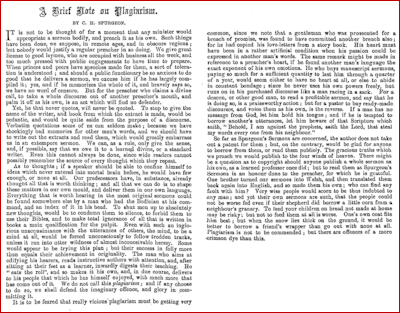
 t is not to be thought of for a moment that any minister would appropriate a sermon bodily, and preach it as his own. Such things have been done, we suppose, in remote ages, and in obscure regions; but nobody would justify a regular preacher in so doing. We give great license to good laymen, who are occupied with business all the week, and too much pressed with public engagements to have time to prepare. When princes and peers have speeches made for them, a sort of toleration is understood; and should a public functionary be so anxious to do good that he delivers a sermon, we excuse him if he has largely compiled it; yes, and if he memorises the bulk of it, and bravely says so, we have no word of censure. But for the preacher who claims a divine call, to take a whole discourse out of another preacher's mouth, and palm it off as his own, is an act which will find no defender.
Yet, he that never quotes, will never be quoted. To stop to give the name of the writer, and book from which the extract is made, would be pedantic, and would break the effect aside from the purpose of a discourse. Verbatim quotations some of us can seldom make; because we have shockingly bad memories for other men's words, and we should have to write out the extracts and read them, which would greatly embarrass us in an extempore sermon. We can, as a rule, only give the sense, and, if possible, say that we owe it to a learned divine, or a standard writer. Even this cannot always be done, since wide readers cannot possibly remember the source of every thought which they repeat.
As to thoughts: if a speaker should be able to confine himself to ideas which never entered into mortal brain before, he would have few enough, or none at all. Our predecessors have, in substance, already thought all that is worth thinking; and all that we can do is to shape these matters in our own mould, and deliver them in our own language. Everything that is worth hearing in the most original sermons could be found somewhere else by a man who had the Bodleian at his command, and an index of it in his head. To shut men up to absolutely new thoughts, would be to condemn them to silence, to forbid them to use their Bibles, and to make total ignorance of all that is written in books a main qualification for the pulpit. Even with such an inglorious unacquaintance with the utterances of others, the mind, to be a mind at all, would be forced unconsciously to follow trodden tracks, unless it ran into utter wildness of almost inconcievable heresy. Some would appear to be trying this plan; but their success in folly more than equals their achievement in originality. The man who aims at edifying his hearers, reads instructive authors with attention, and, after sitting at their feet as a learner, inwardly digests their teaching. He "eats the roll," and so makes it his own, and, in due course, delivers to his people that which he has himself enjoyed, with much more that has come of it. We do not call this plagiarism; and if any choose to do so, we shall defend the imaginary offence, and glory in committing it.
It is to be feared that really vicious plagiarism must be getting very common, since we note that a gentleman who was prosecuted for a breach of promise, was found to have committed another breach also; for he had copied his love-letters from a story book. His heart must have been in a rather artificial condition when his passion could be expressed in another man's words. The same remark might be made in reference to a preacher's heart, if he found another man's language the exact exponent of his own emotions. He who buys manuscript sermons, paying so much for a sufficient quantity to last him through a quarter of a year, would soon either to have no heart at all, or else to abide in constant bondage; since he never uses his own powers freely, but runs on in his purchased discourse like a man racing in a sack. For a deacon, or other good man, to read a profitable sermon, and say that he is doing so, is a praiseworthy action; but for a pastor to buy ready-made discourses, and voice them as his own, is the reverse. If a man has no message from God, let him hold his tongue; and if he is tempted to borrow another's utterances, let him beware of that Scripture which saith, "Behold, I am against the prophets, saith the Lord, that steal my words every one from his neighbour."
So far as Spurgeon's Sermons are concerned, the author does not take out a patent for them; but, on the contrary, would be glad for anyone to borrow from them, or read them publicly. The gracious truths which we preach we would publish to the four winds of heaven. There might be a question as to copyright should anyone publish a whole sermon as his own, as a learned professor once did; but to read them as Spurgeon's Sermons is an honour done to the preacher, for which he is grateful. One brother turned our sermons into Welsh, and then translated them back again into English, and so made them his own; who can find any fault with him? Very wise people would scorn to be thus indebted to any man; and yet their own sermons are such, that the people could not be worse fed even if their shepherd did borrow a little corn from a neighbour's granary. To feed your children on bread not made at home may be risky; but not to feed them at all is worse. One's own coat fits him best; but when the snow lies thick on the ground, it would be better to borrow a friend's wrapper than go out with none at all. Plagiarism is not to be commended; but there are offences of a more crimson dye than this.







No comments:
Post a Comment