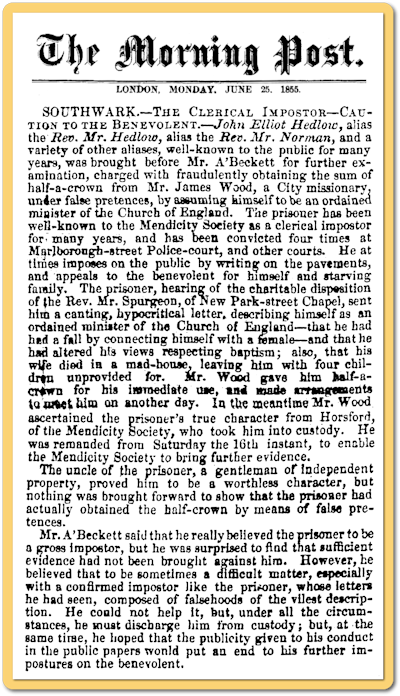
| SOUTHWARK.—THE CLERICAL IMPOSTOR—CAUTION TO THE BENEVOLENT.—John Elliot Hedlow, alias the Rev. Mr. Hedlow, alias the Rev. Mr. Norman, and a variety of other aliases, well-known to the public for many years, was brought before Mr. Á Beckett for further examination, charged with fraudulently obtaining the sum of half-a-crown from Mr. James Wood, a City missionary, under false pretences, by assuming himself to be an ordained minister of the Church of England. The prisoner has been well-known to the Mendicity Society as a clerical impostor for many years, and has been convicted four times at Marlborough-street Police-court, and other courts. He at times imposes on the public by writing on the pavements, and appeals to the benevolent for himself and starving family. The prisoner, hearing of the charitable disposition of the Rev. Mr. Spurgeon, of New Park-street Chapel, sent him a canting, hypocritical letter, describing himself as an ordained minister of the Church of England—that he had had a fall by connecting himself with a female—and that he had altered his views respecting baptism; also, that his wife died in a mad-house, leaving him with four children unprovided for. Mr. Wood gave him half-a-crown for his immediate use, and made arrangements to meet him on another day. In the meantime Mr. Wood ascertained the prisoner's true character from Horsford, of the Mendicity Society, who took him into custody. He was remanded from Saturday the 16th instant, to enable the Mendicity Society to bring further evidence.
The uncle of the prisoner, a gentleman of independent property, proved him to be a worthless character, but nothing was brought forward to show that the prisoner had actually obtained the half-crown by means of false pretences.
Mr. Á Beckett said that he really believed the prisoner to be a gross impostor, but he was surprised to find that sufficient evidence had not been brought against him. However, he believed that to be sometimes a difficult matter, especially with a confirmed impostor like the prisoner, whose letters he had seen, composed of falsehoods of the vilest description. He could not help it, but, under all the circumstances, he must discharge him from custody; but, at the same time, he hoped that the publicity given to his conduct in the public papers would put an end to his further impostures on the benevolent. |
|













No comments:
Post a Comment