
|
A San Antonian's Visit to the Great
Tabernacle—Extract From a
Personal Letter.
DEAR M.......
I have a few spare moments, and as I have just returned from Spurgeon's famous Tabernacle and was much impressed with what I saw and heard there. I will tell you all about it.
I took a cab at Charing Cross Station, where I am stopping, and in fifteen minutes after having paid [no doubt overpaid] the cabbie I found myself at the entrance of the great Tabernacle. I cannot give any correct idea of the exterior of the building, except that it is very ordinary looking and the brickwork somewhat dingy from long exposure to London smoke and grime.
As I entered a deacon hailed me [I knew he was a deacon. Why is that one never mistakes a deacon?] and asked me if I had a ticket, at the same time tendering me one. I was confused and put my hand into my pocket to respond to the rules of the Tabernacle as to price. When he saw my intention he said that there was no regular charge, implying as I thought an irregular one, but he was particular to say that I might put anything that I liked into the large box on my right, which of course I did. After this I felt relieved, as did also the deacon, for he smiled, but not in the San Antonio way, although I would not like to tempt him on a week day. Of course on Sunday it was not to be thought of.
I now thought myself at liberty to enter the races. I mean the race for a good seat. I finally picked out the best, and softest place that was handy, and as the services progressed took the following summary.
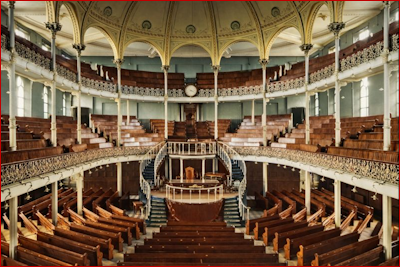
The room is oblong and evidently built for acoustic effects and large seating capacity, which latter I should say was about five thousand. There are two galleries running around the room, and the pulpit is on a level with the first gallery, the choir being just in front of the pulpit. I should think that there were one hundred choir boys, but the singing was of the most simple character and always joined in by the congregation.
By half past ten the Tabernacle was full, and those arriving after that were glad of standing room. All classes were there, but I thought the middle class the more numerous, and there were evidently many strangers. I was impressed that Spurgeon was the teacher of England in a popular sense. Mr. Spurgeon entered the room from the rear, accompanied by several other gentlemen, apparently connected with the church.
His theme was well chosen and his discourse of a character and so handled as to make him beloved by the common and lower classes. I did not notice many aristocratic faces, I suppose because Mr. Spurgeon is really the other people's preacher. And by the way, it seems to me a pity that preachers have to cater to classes. It was not so with the Great Preacher.
A gentleman on my left said that Mr. Spurgeon was not in very robust health, and no doubt his great load of responsibility and work was telling upon him. Of course everything was English from the pulpit to the pronunciation, but I left the church feeling that Mr. Spurgeon was a good man, and on the principle that it is better to be right than to be president, felt drawn to him. He impressed me as having a great heart, and a love for his fellows so strong that he felt called upon to better their condition, and there can be no doubt that the simple though fervid eloquence of Spurgeon has done more to raise the moral tone of London's poor and middle classes than any other one influence.
The Dear Old Man is nearing his end, so his friends fear. When he has gone his place will be hard to fill, both because of his own peculiar genius and power, and also because there are so few nobler and unselfish men in the world.
J. M. E.










No comments:
Post a Comment