A tale from the 25 June 1855 London Police Blotter
Posted by Phil Johnson

 n June of 1855, Charles Spurgeon was just 20 years old. He had accepted the pastorate of the New Park Street Chapel just 14 months earlier, and his fame was already beginning to spread internationally.
For someone so young, he had gained an unusual amount of pastoral skill and wisdom from observing his father and grandfather (both pastors). He had also pastored a medium-sized congregation for a few years at Waterbeach before coming to London. But all his prior pastoral experiences were in small towns and rural settings. Spurgeon was still a bit callow when it came to discerning the schemes of Victorian con-artists who infested the squalid districts of London. He had a warm, generous heart and a passion to help London's teeming masses of needy and destitute people. He was well known for being always generous and charitable—but he was perhaps too gullible at times.
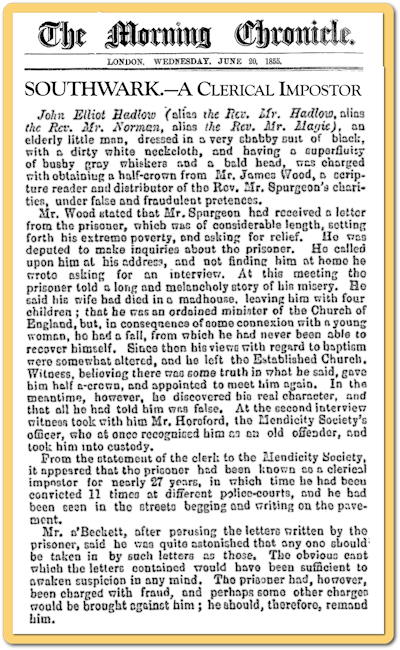
The following incident was reported in all the London newspapers.
SOUTHWARK.—A Clerical Impostor
JOHN ELLIOT HADLOW (alias the Rev. Mr. Hadlow, alias the Rev. Mr. Norman, alias the Rev. Mr. Hague), an elderly little man, dressed in a very shabby suit of black, with a dirty white neckcloth, and having a superfluity of bushy grey whiskers and a bald head, was charged with obtaining a half-crown* from Mr. James Wood, a scripture reader and distributor of the Rev. Mr. Spurgeon's charities, under false and fraudulent pretences.
Mr. Wood stated that Mr. Spurgeon had received a letter from the prisoner, which was of considerable length, setting forth his extreme poverty, and asking for relief. [Mr. Wood] was deputed to make inquiries about the prisoner. He called upon him at his address, and not finding him at home he wrote asking for an interview. At this meeting the prisoner told a long and melancholy story of his misery. He said his wife had died in a madhouse, leaving him with four children; that he was an ordained minister of the Church of England, but, in consequence of some connexion with a young woman, he had a fall, from which he had never been able to recover himself. Since then his views with regard to baptism were somewhat altered, and he left the Established Church. Witness, believing there was some truth in what he said, gave him half a-crown, and appointed to meet him again. In the meantime, however, he discovered his real character, and that all he had told him was false. At the second interview witness took with him Mr. Hereford, the Mendicity Society's officer, who at once recognised him as an old offender, and took him into custody.
From the statement of the clerk to the Mendicity Society, it appeared that the prisoner had been known as a clerical impostor for nearly 27 years, in which time he had been convicted 11 times at different police-courts, and he had been seen in the streets begging and writing on the pavement.
Mr. á Beckett, after perusing the letters written by the prisoner, said he was quite astonished that any one should be taken in by such letters as these. The obvious cant which the letters contained would have been sufficient to awaken suspicion in any mind. The prisoner had, however, been charged with fraud, and perhaps some other charges would be brought against him; he should, therefore, remand him. |
|
* The purchasing power of a half crown would equal between $50 and $100 in 2025 dollars. It was a substantial sum to hand to a vagrant dressed in shabby religious garb.












No comments:
Post a Comment