 I'm back from my weekend trip. We got back early Monday, but I have been too busy to read the blog, much less make a post explaining where I was over the weekend. Sorry to have been so mysterious.
Darlene and I were in Florida. My best friend for almost 35 years is Steve Kreloff, who is celebrating his 25th anniversary as senior pastor of Lakeside Community Chapel in Clearwater. (Incidentally, Steve is now podcasting. I'll add a permanent link in the sidebar when I get a minute.) The Lakeside elders graciously asked me to come and preach as part of Steve's anniversary celebration. My coming was supposed to be a surprise. Steve figured it out anyway. It was still a great day, capped by a long reel of bloopers and comic moments from Steve's preaching career.
Anyway, now I'm back, with an even more hectic week on deck. The illustrious Pecadillo will graduate from the LAPD Academy Friday morning, and hordes of relatives are coming to town for the event. So don't expect me to be very prolific this week.
However, James Spurgeon reminded me today that I began a series on 2 Corinthians 5:21 several weeks ago, and the "series" seems to have stalled right out of the gate.
To tell the truth, I almost forgot I started that. Let's get back to it:
Why put so much weight on the doctrine of justification?
In a post last month, I argued that justification by faith is the marrow of the gospel message. The apostle Paul said something similar in 2 Corinthians 5:21—where he gives a simple, succinct statement of the essence of evangelical truth, with the principles of substitution, imputation, and propitiation all printed in bold type and highlighted.
In other words, justification by faith is no optional second- or third-tier truth. On the contrary, I'd put it at the head of any list of fundamental, non-negotiable doctrines.
Why give such prominence to this one doctrine? After all, there are many other, more widely-agreed-upon doctrines that are absolutely essential to true Christianity. The deity of Christ, His incarnation, His bodily resurrection, and the promise of the second coming—all of those are explicitly named in Scripture as nonnegotiables—essential to true Christianity and essential to authentic faith. Not to mention all the key doctrines of Trinitarianism. Deny any of those and you have in effect departed from the Christian faith. Or the doctrines of the inspiration and authority of Scripture. Abandon your confidence in Scripture, and you have opened the door for every other kind of error.
So why put justification by faith at the head of a list like that?
Justification by faith is unique, I believe, precisely because it distills the pure essence of everything else that is fundamental to and distinctive about Christianity.
Here's what I mean: A person can affirm the deity of Christ, give lip service to the authority and inerrancy of Scripture, be very sound in all the basic points of Trinitarian doctrine—and still come under the curse of Galatians 1:8-9 because he preaches a different gospel.
Someone could also affirm the virgin birth of Christ, have a solid grasp on the incarnation, believe in the bodily resurrection of Christ, and yet be one of those described in Romans 4:4 and Romans 9:32 and Romans 10:3 who—rather than trusting in Christ alone for justification—are seeking to establish a righteousness of their own by works.
In other words, you can be basically sound on Christology or theology proper and unsound on the gospel. If so, believing the wrong gospel will damn you without remedy, regardless of how well-tuned your Trinitarianism is.
The converse is pretty hard to imagine. I've never met anyone who had a sound belief about justification by faith but who was unsound on Christology or Trinitarian doctrine.
After all, if you affirm the principle of imputed righteousness, then you are almost certainly going to affirm the deity of Christ. Because the imputation of righteousness requires a perfect Substitute, with perfect righteousness—as perfect as the heavenly Father is perfect. The only Substitute who qualifies is a Christ who is also God. So the necessity of Christ's deity is practically built right into a sound understanding of justification by faith.
I realize there are probably exceptions to that rule, but it is a plain fact that every major denomination and creed that affirms sola fide also affirms the deity of Christ and all the other doctrines generally referred to as "fundamental."
That's because all the fundamental doctrines of Christianity—the incarnation, substitutionary atonement, the death and resurrection of Jesus, the truth of a Trinitarian Godhead, the doctrine of original sin and the fallenness of all humanity, the freedom of divine grace, and the authority of Scripture—are all linked in one way or another so that the better you understand this doctrine of justification by faith, the more sound you will be in all of your theology.
That's why if you were to ask me to name the one principle in all of theology that is most vital; the one doctrine that carries the most weight; the one conviction to hold most tightly; the one precept most important to handle with care and most vital to proclaim accurately; the one article of faith you need to master well—it would not be a difficult choice. It's the doctrine of justification by faith—the Reformation principle of sola fide. This one doctrine encompasses the heart and soul of everything that is essential to Christianity, everything that is fundamental to our faith.
The doctrine of justification by faith is the very life and nerve of the gospel itself.
That is, I believe, one of the inescapable implications of 2 Corinthians 5:21.
We'll look more closely at the text itself in some upcoming posts. Hang on; this series is far from over.






 Our friend Kevin D. Hendricks at
 We all know the background. Joseph had revelatory reason to believe he'd have ascendancy over his brothers. Possibly boastfully, certainly unwisely, he shared his dreams with his family. That, with his tattletale ways and his daddy's-favorite zoot suit, combined to make him the object of his brothers' hatred. They meant to kill him, then changed their minds and merely sold him into slavery in Egypt, concocting a cock-and-bull story that broke their father's heart and (they hoped) rid their family of Joseph forever.
 life into many events, and say that the brothers meant something for their parts, while God meant something for His. Rather, he encompasses and speaks of the many disparate events as one: "God meant it," the event, viewed as a single complex whole. The same event.
 But it also has application to the discussion that arose over at Adrian's blog, about
 The murder of Jesus was a vast conspiracy involving Rome, Herod, the Gentiles, the Jewish Sanhedrin, and the people of Israel—diverse groups who were seldom fully in accord with one another. In fact, it is significant that the crucifixion of Christ is the only historical event where all those factions worked together to achieve a common goal. All were culpable. All bear the guilt together. The Jews as a race were no more or less blameworthy than the Gentiles.
 The designs of those who killed Christ were entirely murderous. They are by no means exonerated from their evil, just because God's purposes are good. It was still the act of "lawless hands" (Acts 2:23). It was, as far as the human perpetrators were concerned, an act of pure evil. The wickedness of the crucifixion is in no sense mitigated by the fact that God sovereignly ordained it for good. The truth that it was His sovereign plan makes the deed itself no less a diabolical act of murder.
 The cross is therefore the ultimate proof of the utter sovereignty of God. His purposes are always fulfilled in spite of the evil intentions of sinners. God even works His righteousness through the evil acts of unrighteous agents. Far from making Him culpable for their evil, this demonstrates how all He does is good, and how He is able to work all things together for good (Romans 8:28)—even the most wicked deed the powers of evil have ever conspired to carry out.
 So today was my 53rd


 PPPPS: Don't miss
 OK -- I'm up late because I'm an occational insomniac, and I was reading some of the blogs from my side kicks. As I was reading, I ran across a link on one of them which just made me shake my head, and in order not to get involved directly with the controversy, I am going to blog a parable about the controversy, and you-all can take it wherever you want to go.
 I grab him as he teeters over, and I sit him in one of the reading chairs. He's not unconscious, but he's obviously weak and sick. So I go behind the counter, I get a clean rag, and I soak it in rubbing alcohol (which we use to clean our counters and our windows), and I go back to this fellow in distress.
 Ah, the joy of being someone else. Don't we all see traits in others that we wish we could make our own? (Watch out for the ones who answer "No.")
 Ah, but if so, what of Ezra? Ezra was also principled and proactive, but he was of a very different temperament. He, too, faced terrible failure on his people's part. But where Nehemiah exploded, Ezra imploded, and pulled out his own hair (Ezra 9:3).
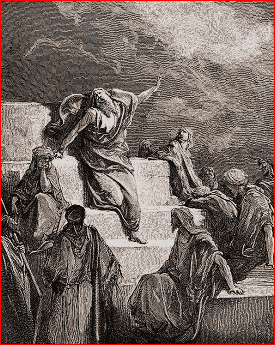 The prophet makes the most astonishing complaint in Jeremiah 20:7-10. It almost sounds blasphemous. He cries out to God that God had overpowered him, that He had given Jeremiah a message that was overwhelmingly negative and offensive, and that it brought him nothing but heartache. What's worse, Jeremiah can't even bear to stop, for if he forbears, the Word is as fire in his bones, and cannot be held in.
 I have tried and tried to connect with Edwards, and I just can't seem to do it. I've read Edwards himself; I've read Murray on Edwards; I've listened to Murray, to Packer, to Piper and others on Edwards. Piper! -- you can't pick up a book of his without his going on about how marvelous Edwards is. And I'm sure to people better than I, Edwards is Da Bomb.
 Surely these are all silly questions. God made the daisy as surely as He made the Indian Paintbrush, the grain of sand as surely as the diamond, the chip of ice as surely as the blazing furnace of our sun.
 A blog that was in my private blogroll long before I entered the blogosphere is the rather inelegantly-named
 Over at
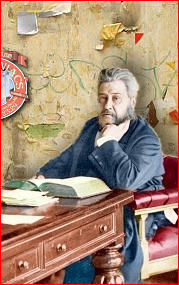 Spurgeon was well known for his evangelistic appeals. As an unregenerate adolescent, under intense conviction about his sin, he listened to sermon after sermon, longing to hear how he could be saved. In the end,
 HOLY MACKEREL! IT'S A TIE!
 During a lull in
 I did some research, for example, and found that the young woman in the picture at the right is
 The esteemed


 If you want watch the spacewalk, tune into